There's an instinctive awareness of evil these days. That means that people are reacting to evil as though it were some common occurrence. People used to shy away from evil, concocting all kinds of ways to deter it, or keep it away from them. Now, they court it.
I wrote to a correspondent:
I think the devil is really rearing his head, and it is not only Obama.
Look at this horrendous, ghoulish, un-artistic piece of "pizza" which this useless creature has produced as art. What lows we have reached.
I went to the Living Arts Centre Gallery a little while ago, not that thought I would find anything exceptional, but to see what's "cooking."
And I found the Pizza Party. Unbelievable.
I am working on a series of posts (here is The Aggression of the Alien (Alienated) Asian Artists: 1. Tammy Tang: Employing Less Materiality which I've completed) on Chinese artists in Mississauga, and the now clearly fetishistic admiration of Asians by whites, to the detriment of other whites. I have already noted in posts dating as far back as two years ago the Asian Female/White Male coupling, where white women are abandoned by these hypocritical, liberal, feminist white men (they are equally to blame in pushing the feminist agenda which has been the ruin of white women), but since they need "women" as their mates, not testosterone/estrogen filled monsters, they have found those savvy Asian women who know just how to trap them.
This "Pizza Party" guy, An Dy, from what I can gather, is a homosexual. The gallery curators are a bunch of feminist women. This particular show they curated is on "recent art school graduates," and they have disproportionately curated works by Asian artists. I emailed one of them what their criteria was, and she just sent me a link to the exhibition website. The white artists in the show have superior work, but I should say that the Asians are also good, but at a lower ability than the whites.
The Asians have also used their art to make "Asian" statements.
So, we are slowly being encroached by this aggressive, alienated, anti-white group, as I titled the blog article, which is also subtly inferior, and I also think envious. It is also strong.
The multi-culti rebellion (demonic war, I should call it) has reached a newer, more vicious, evil level.
Below is a dove I saw flying from tree to tree, and then it decided to stop by a small patch of grass, where it pecked at some seeds. I had drawn a portrait of one a couple of years ago, but the photo I used came from Wikipedia!
Confession: I have never seen a real-live mourning dove, although I have heard its lovely sound (in the Philadelphia area, last Spring).
Below is a photograph I managed to catch of this fleeting dove, and below that is my rendition of one perched on a branch.
I thought for a long time that it was "morning dove" but it is perhap apt that it be "mourning." Animal sounds often give us the mood of the times. A mourning dove, reminding us that we should be aware of what we are losing, and as my modest blog attempts to do, to reclaim it once again.
An on-going exhibition at the Living Arts Centre Gallery in Mississauga is titled More Decent Exposure, which is:
...the culminating exhibition from a call for submissions to students and new graduates of post-secondary arts and design institutions. From over seventy entries by emerging artists, exhibition jurors short listed twelve applicants whose works represent new trends in contemporary practice across a wide range of disciplines. Acting as a window to the near-future of visual arts, the collection is an exciting and challenging application of new materials and ideas. This is the second exhibition of its kind, the first was DECENT EXPOSURE, 2012.
One whose work "represents new trends in contemporary practice" is An Dy (Andy, I suppose) who has a painting selected for the exhibition titiled: Pizza Party.
I took the two images below on my last visit (with clenched teeth, the whole experience was unpleasant, and I only went through it for the photos I was able to get!). They are close-ups of the masterpiece.
Here is An DY's Facebook page, with other ghoulish gems.
Tammy Tang In Sum Mattress, Salt, Vinegar [Source: Tammy Tang's tumbler page
Tang's title on this on-line version, In Sum, is different from the exhibition version at the Art Gallery of Mississauga, which is Hers Soul (see below for the image in the gallery). Why did Tang change the title? And why is her phrasing grammatically wrong? Is she trying to be one of those postmodern, witty, artists who love to "play with words" to make up for their artistic deficiencies? I tried to figure it out.
"Hers, Soul" with a comma might have made some sense as "Hers is her soul" but "Hers Soul?" I think it is simply a deficiency in language. It is a mistake.
Below is a photograph I took of the object in the Art Gallery of Mississauga, and the label below is also a shot from the show.
Tang explains her art in a written statement. Again, her writing is clumsy with small grammatical errors. I wonder if this is how Asians are to speak and write English, developing their own idioms? And Tang's writing is also filled with the cliches of postmodern art: "penetrable boundary," "ephemeral," "embrace the chaos."
My practice explores the penetrable boundary between the physical and the psychological, imperceptible nature of memory. Addressing the relationship between individual's internal feelings, struggles, and conflicts within the surroundings. Develop an ephemeral silence for the viewers to bear, reconfigure the role of uncertainty and embrace the chaos.
Yes, dump a mattress in an Art Gallery, and get the hijacked visitor to deal with that!
Tang cites the following three artists as influences on her "mattress" work:
I tried to find the connection between these artists and Tang's mattress, but, her choices are probably arbitrary, and based on some phrase or commentary they made on art, rather than their actual work.
This might be closer than the others, After all Tang gave us a dishevelled bed, which she tried to purify with vinegar (clean off the "dirt?"). As usual with contemporary, postmodern art, there is a subliminal, hidden sexual theme in the work.
Here is Kiki SMith's Born, where the rape begat the child, so everything is clean and good:
Kiki Smith (American, born Germany, 1954) Born, 2002. Lithograph, 68 x 56 in. (172.7 x 142.2 cm) Brooklyn Museum, Emily Winthrop Miles Fund, 2003
And Ann Hamilton's simple use of ordinary items may have caught her attention. But then, it could just be as simple as Hamilton's photography on the Mekong River, in the Orient (Laos), may have found something sympathetic in her.
Ann Hamilton From: Meditation Boat The abadoned walking meditation halls of Luang Praban's monasteries inspired the boat's form and function
It is interesting that Tang mentions no-where the King of the Mattress (or unmade bed): Rauchenberg! After all, he used a cast-off bed (like hers "found" futon) to construct his object.
Robert Rauschenberg Bed 1955 Oil and pencil on pillow, quilt, and sheet on wood supports, 6' 3 1/4" x 31 1/2" x 8" Museum of Modern Art, New York
But then, art history beyond the contemporary postmodernism, prior to say, 1995, would be too far back in time!
Here is is an article on four of the beds of the post-modern art era (unmade, unaesthetic, suggestive and even lewd, sexualized), with Rauschenberg's bed as the role model, and with the final line: "Here’s to adding to that history!"
I suppose Tang just might become part of that "history."
Or maybe she was thinking of John Lennon and Yoko Ono, that "avant garde artist" who did a Bed In right here in Canada!
Annie Liebovitz Photograph for Magazine Cover Rolling Stone January 22, 1981
“…Later that afternoon, John was murdered… The way these events played out is an excellent example of how circumstances change a picture. It’s like when you think of the picture and suddenly the photograph has a story”.
Annie Liebovitz is the lesbian photographer who bizarrely was "moved" by this multi-racial couple's "kiss" from Lennon's album cover Double Fantasy. What was it that turned her on? Not the kiss by two heterosexuals, but the unconventionality of the couple.
And rather than repeat this kiss, she went further and imagined them with their clothes off. Here she recounts her interaction with the two at the photo shoot.
So here is Tang's subconscious reference: Yoko Ono as a role model. An aggressive Asian to emulate!
But I believe the real reason that Tang creates such unaesthetic, formless art is because she has no images to emulate.
What does she do: Chinese art or Canadian art; Western art or Eastern art?
Chinese artists in the West have resumed their oriental practices and reproduced their Chinese art. But, their works are bland and repetitive. Others (a few) have tried to incorporate Western art and history into their work, but they don't maintain this for long. So, either they resume their Chinese art, or go the "modern" way, where art becomes a negative representation of society, dark, nihilistic, and critical. Their alien, and alienated, situation forces them in this direction.
I believe this is the direction that Tang has taken, where she feels compelled to create art, but has no subject matter, no images, to describe, reproduce and create.
She says as much here in her very brief biography:
Tammy Tang is a sculptress resides in ON(sic). She was born in Hong Kong. Tang studied Art and Art History, Sociology and Women Gender Studies at University of Toronto. Tang often used the found material as a medium in her work. As they carried significant histories and meanings from their past activities, they provided a rich sensation to the work...The majority of Tang's work reflects her critical view to social and environmental issues that derived from her personal experiences and struggles in the West and East. Tang's work now starting to focus on the employing of less materiality in order to give away a dense vision....
Tammy Tang, in front of her installation: This is Float, 2015, Salt, Food Colouring, Cheese Cloth, Various Glasses Containers
Exhibited at the student programHabitual at Sheridan College.
She describes the work thus:
I used the decomposition reaction in salt to create salt crystals that would represent a formation of human body. And the process of crystals decaying, when time goes by, symbolized human ashes formation after body being burnt on funeral pyre. The work becomes a model for acknowledging the inevitability of change in human life.
I recenlty wrote about a The Big New Yorker Book of Dogs, a book I had just purchased, whereas in fact, I had bought two books.
For some reason, I didn't feel up to commenting on this second one.
It is Anne-Marie O'Connor's The Lady in Gold, the Extraordinary Tale of Gustav Klimt's Masterpiece, Portrait of Adele Bloch-Bauer.
I started to write about the (beginning) of the book, and here is what I wrote about three days ago. I started by writing the very first line of the book:
It was 1898, and the devil himself seemed to dance in Vienna.
This is the first line of the first chapter of: The Lady in Gold: The Extraordinary Tale of Gustav Klimt's Masterpiece, Portrait of Adele Bloch-Bauer.
I stopped reading the book after the first chapter, to do more research on the painting. As I looked closer at what I found online, I realized that the "designs" on Adele Bloch-Bauer's dress (the Woman in Gold) looked like some Egyptian heiroglyphic eyes.
Here is more, just from the first two pages:
For hundreds of years, the great Habsburg dynasty had reigned over this crossroad of East and West. Behind immense battlements, its frilly court united German, Italian, Polish Czech, Hungarian, and Croatian aristocracies into a single royal house whose multicultural capital was as ornate as a Faberge egg.
[...]
Now Vieanna's ancient ramparts had come tumbling down, and a wave of newcomers was crowding in from Bohemia, Moravia, Galicia, and Transylvania.
[...]
This new Vienna was a city of contradictions. It was one of Europe's richest cities, yet its immigrants were among the poorest. The construction of opulent new palaces did little to hide a severe housing shortage. Vienna doctors were creating modern medicine - pioneering surgeries; discovering germs, the polio virus, and blood types - yet incurable syphilis spread unchecked. Sigmund Freud was illuminating hidden drives of sex and aggression at a time of xenophobia and anti-Semitism so crude that some believed Jews murdered children to leaven their matzoh with blood.
[...]
The dynasty that had united Europe and the Americas had become the empire's premier dysfunctional family.
[...]
...wrote the appalled director of the Burghtheater. "The devil is loose here...in one single night, the Viennese went with him."
[...]
Yet even in this "Gay Apocalypse" Vienna maintained a deeply old-fashioned charm, with its snow-covered palaces and strolling parks, its aromatic cafes and seductive pastry carts piled with petit fours and chocolate bonbons filled with sweet liqueur. Possessed of a childlike love of adornment, Vienna was a city where gilded iron roses climbed balconies and stone goddesses framed doorways; where gargoyles glared from cornices and Herculean men bared their immense chests from facades.
[...]
In 1989, Vienna was a place where illusions could still be preserved by well-to-do families like the Bauers, who gathered at their elegant apartment above the Ringstrasse on a March afternoon, when the musky sweetness of lilacs filled the damp air.
Adele Bauer was standing before the family in a white Grecian robe, revealing a slender frame as long and delicate as a vase. Her thick hair fell to her waist. At sixteen, Adele was crossing that mysterious line between girl and woman. Dressed as the spirit of Spring, she held a wicker cornucopia filled with Spring blossoms and sheaves. with her poise and regal bearing and her dark, heavily lidded eyes, Adele might have been an actress, like Katharina Schratt, who ruled a few steps down the Ringstrasse, at the Burgtheater.
So begins a book which through the guise of telling us about a painting is also a story about how a country got seduced by beauty, and used it as an idolatory replacement.
It is no surprise that Hitler, the dancing devil, was so easily able to seduce the German people, who marched with him singing their beautiful Germanic songs, as he led the way to his Gottesdammerung.
I returned the book. I couldn't read it. It celebrated Klimt, who with his golden paintings, glorified this devil and left God on the wayside, or so he thought. The devil may dance around God, but God is permanent.
I returned the book, and the nice lady who helped me purchase it patiently listened to why I returned it.
"I got spooked by the "evil eyes" I started to explain.
The last time went to the Fraunces Tavern Museum website (only about a week ago), I didn't notice this new acquisition:
Fraunces Tavern Museum is proud to announce the most recent acquisition, a terra cotta bust of George Washington. This bust is a 19th century draped a l ‘antique unsigned copy of the original bust made by Jean-Antoine Houdon in 1785.
I've written about this bust here and here. And, Larry Auster, whose admiration of the bust I shared, wrote about the bust, and made a post here on my commentary on the sculpture.
Although Larry Auster didn't directly write about beauty, his work is infused with the desire to bring beauty back into our world.
One of the most memorable posts he did on art (and beauty) was his reaction to a bust of George Washington. The image of the bust he has posted is huge and takes up the whole screen, so that we, like him, can have as close a look at it as possible. [the rest of my post is here]
So, it is a nice surprise that a museum is bringing this piece into its collections.
It was recommended to me by a staff at my local Chapters/Indigo bookstore, when I asked her for her advice. "I'm pretty sure you'll like this" she said. She had previously assisted me in finding/ordering/buying the two other books I recently bought - Ann Coulter's Adios America, which I've written/reviewed here, and The Founding Fathers at Home: The Building of America, 1735-1817, which became a delightful journey into the homes of these Founding Fathers, and about which I've written a brief post here. They are both serious books, Coulter's more so, but engaging and witty, and Magnate's is a joy to read about the homes, and rooms, where these American men conceived so many of their ideas.
If my quota weren't already over I would also buy a dog book. Now, dog books are a dime a dozen. Everybody has a Fido to biographize. But the New Yorker's book: The Big New Yorker Book of Dogs, which I saw online, is described thus:
Only The New Yorker could fetch such an unbelievable roster of talent on the subject of man’s best friend. This copious collection, beautifully illustrated in full color, features articles, fiction, humor, poems, cartoons, cover art, drafts, and drawings from the magazine’s archives.
These authors take their dog a tad too seriously. But such is the honor we should bestow our dog, loyal, silent (except for the bark or the growl to protect his master) playful, and infinitely patient. But, once in a while we should make gentle jokes about him. He is, after all, a dog.
As does Kurt Vonnegut, whose loopy novels I avidly read. In his book The Sirens of Titan, Kazak the dog (who has appeared in previous Vonnegut novels) belongs to Rumfoord, who comes:
...from a wealthy New England background. His private fortune was large enough to fund the construction of a personal spacecraft, and he became a space explorer. Traveling between Earth and Mars, his ship - carrying Rumfoord and his dog, Kazak - entered a phenomenon known as a chrono-synclastic infundibulum, which is defined in the novel as "those places ... where all the different kinds of truths fit together."
Even in outer-space, and a dog as sole companion, truth is important to decipher.
I might break my (personal) contract, and just buy Vonnegut's parody. He does have a dog as a protagonist, after all!
Now, onto those metaphorical dogs, or more appropriately, wolves. In the Garden of Beasts: Love, Terror and an America Family in Hitler's Berlin, by Erik Larsen is:
...a disturbing but highly compelling account of the life of the American ambassador to Germany and his family during Hitler’s rise to power. Larson, author of “The Devil in the White City” and other bestsellers, focuses on a narrow yet intriguing chapter of the buildup to the war: what life was like in Berlin among the social and political elite as Hitler became chancellor, told through the eyes of a most unusual ambassador and his family.
The Hitler regime is fascinatingly macabre. How could a whole civilization be taken in by this impostor? My layman's, naive, conclusion is that people abandoned God, and could no longer differentiate between good and evil, and between truth and falsehood, and in fact supported evil.
My latest book acquisition, mine for only a day now, is: The Lady in Gold: The Extraordinary Tale of Gustav Klimt's Masterpiece, Portrait of Adele Bloch Bauer. It is about the wolves of history, the Nazis.
Anne Marie O'Connor...deeply researched account of the Bloch-Bauer case, "The Lady in Gold," concentrates almost entirely on the Neue Galerie's picture - along with the Belvedere's "The Kiss" (1907), the pre-eminent example of Klimt's now celebrated gold-leaf style - and the wrenching 20th-century tragedy of Vienna's highly assimilated Jewish elite. She has constructed a sprawling "saga of loss and redemption" that is as much an impassioned elegy for a "golden instant when Vienna rivaled Paris" as a dissection of the restitution battle that led to the Christie's sale.
The case is straightforward enough: The daughter of one of the leading bankers of the Austro-Hungarian empire, Adele Bloch-Bauer was a patron (and perhaps lover) of Klimt and a fervent supporter of public museums. In 1923, two years before her death, she wrote a will expressing her wish to have her Klimts given to the [Vienna's] Belvedere [Gallery] upon the death of her husband, the industrialist Ferdinand Bloch-Bauer. Following the 1938 Anschluss, however, Ferdinand's assets, including the paintings, were expropriated by the Nazis -"Aryanized"- and he fled to Czechoslovakia and then Switzerland, where he died in 1945. After the war, the Belvedere asserted title to the paintings, citing the 1923 will.
By the 1990s, however, Austria was drawing belated scrutiny for its handling of art looted by the Nazis, and, in 1998, the remaining Bloch-Bauer descendants, all living abroad, asserted claim to the five Klimts. Leading this effort were Maria Altmann, the octogenarian niece of Adele, and a crusading young American lawyer named Randol Schoenberg, who happened to be the grandson of the Austrian composer (and fellow émigré) Arnold Schoenberg. After a protracted legal battle, an Austrian restitution panel ruled in favor of the heirs in January 2006.
[...]
The central and largest section of Ms. O'Connor's book is devoted to the brutal destruction of their Vienna [by the Nazis].
When I travel into the US, on my long but wonderful bus ride across New York state, I often see the American flag hanging at the front porches of people's homes. It is wonderful to see that Americans still value their flag, and display it, paying no attention to those who try to vilify them with "far right racists" commentary.
Americans are becoming more and more apologetic about their wonderful flag, but here is a painting I posted in 2011 by an American painter, Hassam Childe, who titled this particular flag painting (he did several) he painted in 1916:
The Fourth of July, 1916 (The Greatest Display of the American Flag Ever Seen in New York, Climax of the Preparedness Parade in May)
I hope that Americans return to that bold, courageous, unapologatic love of their flag and their country.
Happy Fourth of July!
Childe Hassam (American, 1859–1935)
The Fourth of July, 1916 (The Greatest Display of the American Flag Ever Seen in New York, Climax of the Preparedness Parade in May), 1916
In 1916 Hassam embarked upon the Flag series, based on the nationalistic displays of flags, banners, and bunting on the buildings that lined Manhattan streets in response to World War I. During an unusual summer visit to the city, Hassam created this exceptional canvas, one of only two sunny summer flag scenes. While he denoted the site as Fifth Avenue by showing its tall buildings and a green double-decker bus, he obscured the precise location, perhaps to imply that the entire length of the great boulevard was bedecked with flags.
The links I provided in 2011 for the painting are no longer valid at the Metropolitan Museum's website.
Searching on-line, I found that the painting is actually from a private collection. The best explanation I can find is that the painting was on loan for a Childe exhibition at the Metropolitan in 2004. Here is some more information from the Met's website:
Childe Hassam: American Impressionist June 10–September 12, 2004
This spring [2004], The Metropolitan Museum of Art will offer Childe Hassam, American Impressionist, an unprecedented exhibition of about 120 of Hassam's finest oil paintings, watercolors, and pastels, and some 30 prints. Opening on June 10, the retrospective -- the first to appear in a museum since 1972 -- will celebrate Hassam's brilliant handling of color and light and will examine his responses to the advent of the modern era in view of his credo that "the man who will go down to posterity is the man who paints his own time and the scenes of every-day life around him."
And the painting is listed as one of the pieces to be exhibited.
George Washington, 1780 Charles Willson Peale (American, 1741–1827) Oil on canvas; 95 x 61 3/4 in. Metropolitan Museum of Art, New York
Part of what makes his live story so gripping is that he shaped himself into the world-historical figure he became, in the quintessentially American tradition of men who spring, as F. Scott Fitzgerald famously wrote, from their own Platonic conception of themselves. But his self-conception was extraordinary: it began as a worthy ideal and evolved into a magnificent one. In his fiercely ambitious youth, he sought to win acclaim for his for his heroism and savoir faire. In his maturity, he strove to be, in his own conscience even more than in the eyes of others, virtuous, public-spirited, and (although his ethic wouldn't allow him to claim the word (noble). He did hope, however, that posterity would recognize and honor the purity of his motives; and Americans, who owe him so much, do him but justice in understanding not only what he did for them but also what greatness of soul he achieved to do it.
Meena Chopra: Poetess, Artist, Oriental Goddess Par Excellence
I started a small project, which should have been simple enough, but I entered territory which I thought I had long abandoned: that of directly confronting liberal Canada. And I quickly realized how far worse things had become.
There are two universities nearby: Sheridan College and The University of Toronto's Mississauga campus. The schools were accommodating enough, telling me to fill in forms, and giving me the rates for renting out rooms for the event.
Then I went to the cultural centers, including the Art Gallery of Mississauga, which provide meeting rooms for lease. I thought having the lecture in the middle of paintings and sculptures would accentuate the concept of beauty.
I also visited parks, gardens and nature conservations, which also earn some of their keep through leasing out their halls. Beauty, art and nature seemed a fitting combination.
There is also a large branch of Mississauga's public library, and it was the Canadiana Room, a small research center in the library which caught my attention. I had submitted the Crosby book to be included in the library's collections, and I thought that having them lecture in the library would be fitting.
The library's website presents the Canadiana Room thus:
The Canadiana Reading Room, located on the 3rd floor of Mississauga Central Library, offers in-depth research resources for the study of Mississauga history, as well as extensive material on early Ontario history and selected Canadian history.
Besides its unique collections, the room has chairs, tables and book cases of pleasant light brown wood. The room is almost always empty, unlike the rest of the library which is full of patrons of mostly students preparing for their classes.
Marian Kutarna, who as far as I can tell is "Manager: Arts and History Department" of the library, although there appears to be someone of higher authority than her, was apparently the one to interact with when booking this room. And she is important not because she finds empty spaces in the booking manual, but because she decides who gets in and who doesn't.
She is cleverly stupid, as all fascistic gate-keepers are, especially if they are trying to be the "good guys." I realized quikcly, for instance, that she was trying to avoid an "email trial."
I sent her at least three emails at the beginning, and she never answered any of them. I then kept returning to the Canadiana room, to ask her various assistants (and volunteers - libraries love to use their hapless patrons as "volunteers") what I should expect, and also to do some independent research. I got mixed-messages from her assistants: "She is in a meeting" and hopeful ones: "We're taking this project on," and still nothing, until I figured out the hours she worked, and went at those times.
She was effusive, friendly and fake. I caught on, and asked if she would email me the reasons why she wouldn't have the event in the room, especially since, through some research in the library's database, I found that the Canadiana Room had sponsored and organized other author talks. And these authors are primarily non-white and non-Western.
So that was probably my answer. And that was probably why Kutarna was trying to keep her email track as bare as possible, to avoid just the kinds of questions I was asking her. But, her stupidity is apparent, since lack of a response is just as incriminating as giving a response, and maybe more so.
But I think that her silence was actually her inability to respond to me. "How can a brown-skinned person (me) praise the West so openly and follow its exmaples so directly? Who is this creature! She is even worse than those racist whites, since how can she be racist towards her own race!!" Hence her debilitating (I think) inaction.
I finally got a few emails from her. In the first, she said that the Canadiana Room is not "a bookable public space." It is a bookable space, though, with the agenda of its staff. I said as much, and left her with "I will take the matter further."
I sent an email to the library's grievance committee saying I would like to report a complaint, but left it at that. Kutarna seems to have been updated with all my communications with other departments regarding room bookings. And she made me sound like some kind of furtive criminal, where in the first of her emails she wrote, "I know that you have reached out to City and Library staff, including myself, to identify a possible venue for your event." So she will know about my report. But I don't have time to pursue my complaint. The library will continue to decline and wither as it accommodates itself to special interest ethnic groups. And I will avoid going there. I go there very rarely, anyway, and there are a myriad of other ways to do research, and to borrow books, in this modern, technological age.
Kutarna is of course reacting to my "Western Civilization" program which doesn't fit in with this now depressingly prevalent "inclusive" ideology that dominates all cultural discussions in Canada, and the West. And what this really means is restricting and reducing anything related to whites and the West to give priority to non-whites. And Kutarna has grasped on to this multicultural ideology full on.
As with all the fascist, white females of our era, Kutarna is a pathetic creature. She is many pounds over-weight, which affects everything about her, from the lop-sided fit of her dresses to her unattractive haircut. She will blame this on the West and whites, since they are the ones who produced this horrible world which makes people like her suffer (and gain weight) by putting so much importance on appearance!
So, she turns to those ethnics, those brown-skinned people, who are so poetic, so artistic, so vibrant, so beautiful, so real. They become her mentors, allies and examples, being so kind and sensitive, and so ready to give. Of course, this is only her illusion, since their priority is to their own, and try as she might, she can never be part of them.
And I found in my online investigation of her, this gem of a video, where she sings her praises to the ethnics of Canada, and one in particular, in just five minutes.
In the video below, Kutarna is bestowing her reverence to the goddess-poetess Meena Chopra who is a Canada-based (Canadian national) Indian, who writes poetry. Chopra was honored in 2010 in an event in the Mississauga Central Library (not in the Canadiana Room, which would have been too small for that event) titled "A Multilingual Poetry Celebration and Book Launch" as she read from her book amidst Indian dignitaries, as well as Kutarna who gave a speech (excerpted below).
An excerpt from the above video of Kutarna's speech:
I have to say something. Meena taught me something...We were on the phone last Fall talking about doing this workshop, celebration. And I said "Meena, read me a poem, read me a poem" [hand gestures, which look like Indian hand gestures]. "She said: 'But they're in Hindi!' "Read me a poem" [Kutarna's voice increases in pitch - (and desperation?)]. She read me a poem, and this is what I learned. The sound of a language is poetry. The human heart is the same heart in all of us.
For Kutarna, we don't need to know what the exotic, foreign poet is saying. It is sufficient, nay, holy, to simply hear the sounds he makes. We don't need to understand this sacred other since we can feel his specialness, just by the way he utters his words.
And Chopra is the Indian, Third World Goddess that has evoked Kutarna's awe and wonder.
And Chopra knows this. She and her world are systematically undermining and curtailing the white West's civilization. She says so, clearly, in this presentation:
World is transitioning into a global village where English language is taking the front seat but not in a traditional British, American or any other way. [I suspect the grammatical deficiency might be because these are the notes she was reading at the lecture, but submitting that for publication is lax and lazy.
She then continues to talk of the "visual" importance of modern-day communications, neglecting the small fact that she is reciting her poetry in words, and specifically her Hindi words, to make a linguistic point.
But, rather than talk about this usurpation of the English language by non-Anglo worlds, and discussing their variations on the English language, including the addition of many non-English words, she deviates from this by writing:
The biggest influence on new English is of the technological culture and the dynamism of the young who are the creative compelling users of technology.
(I should add here that Chopra's written text is probably the notes she was reading from at the lecture. And for a literary person, one would expect her final version of her transcript that she sends for publication not to include so many errors).
She says that now, since the English language has become this universal world language, and where the Third World has appropriated it to suit its cultural needs, a new generation is using it in a very different, visual way.
I don't think Chopra knows what she's talking about. She doesn't have a well thought-out thesis, and seems to support at times the linguistic idea and at others the visual one.
At another installation of this post, I will write (as I have written previously, but less forcefully) about the intellectual laxness of these non-Western sophisticates.
But they have come to squat, invasion style, in a world which they incessantly criticize, but which is a world replete with sophistications (such as first-class libraries where they can shelve their books so others can easily find them and read them) for which they are willing to immigrate thousands of miles.
Kutarna with Chopra, holding Chopra's book of poems Ignited Lines
I find Chopra uncomfortable with the effusive admiration from Kutarna, who stands grinning obliviously
Chopra is of course a seasoned ethnicist, who has used Candada's infrastructure to its maximum. She is "Friend of the Library" at its most opportunistic.
Below is Chopra reading a poem with those special sounds.
And Chopra also promotes herself as a visual artist. I suppose this is where she empathizes with the world of the "young" where she continues with the presentation I've quoted above:
The idiom and syntax are changing fast.
Manifestation of the subtle thought imaging is taking over directly from the mental sound vibrations in a language where we have started expressing in symbols like smilyes, pictograms and info-graphics etc.
I remember seeing a collection of Chopra's paintings and drawings at the Living Arts Centre here in Mississauga. The center is trying to promote the various arts, and has a full-scale concert hall, a gallery, and various artists' workshops. It is quite a formidable building. I saw Chopra's work hanging somewhere in the gallery, and looking online, I realized it was at the LIVE Restaurant, which is mostly used for after-concert meals and refreshments.
The center, including the restaurant, is partially funded by government grants, and is losing money, and is accepting all kinds of bizarre events to cover its costs. One recent one was a body builders gathering, where strange, inflated creatures were wandering around the hallway. Another is to hold various ethnic festivals, and their program includes a recent presentation by a Chinese circus and an Indian event to celebrate one of their gods. Chopra's program fits that bill.
I couldn't find much online on her paintings at the center, so I went back to LIVE Restaurant, and indeed, there were Chopra's works.
Her show is titled:
"SHE: A Restless Streak" Art Show by Meena Chopra CELEBRATING THE SPIRIT OF WOMANHOOD
And it is:
At "Live Cuisine" at Living Arts Centre Mississauga from March 9, 2015 until May 25, 2015. 4141 Living Arts Drive, Mississauga, Ontario Mississauga, Ontario L5B
9thMarch to 25th May 10:30am to 5:30pm everyday
Below is a drawing hanging at the LIVE restaurant, but which I also found online. The photograph of her paintings hanging in the restaurant is what I took, as well as the view of the LIVE restaurant's entrance.
Drawing: Meena Chopra Pastel on paper 11'x8" From Chopra's series: She: A Restless Streak
Poem Excerpt from Chopra's poem Iconoclast (full poem below) The real in her longs to be revealed through layers seeking identifications undraped in a figureless formless existence.
Iconoclast Is she a vase or a statue on a pedestal ?
She is no icon!
Her feet strong firm on ground. The earth supports her. The real in her longs to be revealed through layers seeking identifications undraped in a figureless formless existence.
In vain, she searches - an iconoclast, beyond the turbidity of love.
Will she find one in you ?
Is this the forceful Hindu Goddess, the statue on a pedestal, that Kutarna is looking for? Will she find this figureless, formless, elusive creature?
Chopra may present herself as a modern, progressive oriental with Western ideas. But, as we look deeper into her thoughts, she remains much more Indian than Western. And she is not forthright with Kutarna, whom she will surely abandon when her authentic "identity" trumps pleasantries, leaving Kutarna with nothing but those incomprehensible sounds.
Art and Gastronomie
Chopra's works hanging above wine glasses and folded napkins: the epitome of Western sophistication, but with the Eastern content
Hanging here are oil paintings "Hope" and "Afloat" and selling for $285.
An Indian Woman at the LIVE Restaurant
At one time (about a year ago) the restaurant had changed its buffet style menu from an exclusively European menu and had added one or two Indian dishes. I asked recently about booking the restaurant, and found out that one of the chefs was Indian. When I looked at the buffet, the menu included only one Indian dish, and that was a simple chickpea dip. I asked to meet the chef to inquire about group rates, and was introduced to what looked like a cook. "You can order anything you want. Yes, we can do Indian dishes, butter chicken, anything."
My conclusion was that the attempt to turn this wonderful little place into an Indian/Ethnic restaurant didn't work. How many folk festivals are there going to be, and how many are "inclusive" enough to attract a wider audience than just Indians?
Chopra's work is hardly that of the goddess/artist of Kutarna's eulogy. She has managed to convince the ethnicist Indians who still require the admiration of white Canadians - and they got one at least via Kutarna, and those multi-culti whites who still run the organizations that she is worthy of their attention. And, following the multi-culti/ethnicist recipe, that is not hard to to. I don't doubt that Chopra has artistic ability, but she wouldn't have reached such a level of recognition hadn't she had all these underlying "qualities."
At the same time as Chopra's presence in downtown Mississauga, there is a photography exhibit in the Living Arts Centre by David Hook, a photographer based in Mississauga. The show is titled: Southern Ontario Mill Ruins. It looks like Chopra's attempted prediction of the decline of Western civilization is being admitted by whites. But it is more complex than that. When artists begin to realize that their civilization is in decline, and they begin to document what they have, as well as what is being lost, I think it is a good sign. It means that they may be more alert and aware of their surroundings, and will ask difficult questions such as "Why are we losing all this?" and "What is causing that?" And from there, some kind of action can originate. At least, that is what I hope.
The photocopied paper describing this exhibition has a quote by Hook:
"Here in Southern Ontario, we don't have many of the features that are common elements in landscape photography such as tall mountain ranges or ocean scenes. Yet Southern Ontario has a beauty all of its own. We many not have the historic ruins that you find in Europe, but we have our history to be captured here. My goal is to seek out and capture the hidden beauty in Southern Ontario that many may take for granted."
How different that is from Chopra's world (which I quoted above with its grammatical inaccuracies), which is:
...transitioning into a global village where English language is taking the front seat but not in a traditional British, American or any other way.
The narcissistic "identity" Chopra is seeking is obvious, as she describes it in the quote by her also in this photocopied program:
"My art is my search for the moments beyond the ones of self knowledge. It is the rhythmic fantasy; a restless streak which looks for its own fulfillment! A stillness that moves within! An intense search for my origin and ultimate identity."
And Chopra adds more of her inner "conflicts" here, where she is constantly trying to recreate that origin and identity transplanted from a foreign place into a Canada she never is able to call home and where she is never able to be at peace:
Serene surroundings of my birth place Nainital a hill resort in India have been a source of inspiration to me always. Strangely enough the beauty of Canada reminds me of my birth place a lot. Significantly the immenseness of the sky, the glory of the setting sun with its ever-changing colors and the unlimited wide expanse of the earth stills my nature within.
And more ominously, here is an excerpt of Chopra's poem Fire:
Dreams tumble from unknown heights into a dark pit devoured by the hunger for light. A vast ultimate flux of shadows adrift, a sea of hidden fire, rises with a smoky thread to reach the hearts of early desires"
Such are the aliens that are now populating our land, changing it more aggressively and determinedly than ever, and with all the Kutarna's on their side.
We have a battle, although I would say it is a war, ahead of us.
Below is a photograph by David Hook, which he titles Turnbull Mill Ruins.
David Hook Turnbull Mill Ruins, Cambridge, Ontario, 2014 More of Hook's photography here
Hook may be photographing ruins, but it is to capture history. His quest is not a relocation to a far-off, abandoned place, but one closer geographically. It is not the fantasy land that Chopra is recreating, but something more real and tangible. His ruins give us a sense of the past, to bring into the present and to create for the future.
Chopra vacillates between heights and dark pits, to find her "identity" with a "hunger for light." She is for ever in an elusive, intangible ephemera. It is not a narcissist's quest what she is in, but a rootlessness that must be common to so many like her, now populating the urban and even rural landscapes of our lands.
I continued to work for several weeks researching conference locations, contacting groups and institutions, and communicating with individuals to prepare the conference for the Hildebrand project leaders. I wrote asking them if they were interested in coming to Mississauga to present their book and their ideas.
Here is a couple of the emails I received from their office:
I have not heard an official word from either of the Crosbys yet about this opportunity, however, we have been in the midst of creating a master list for speaking opportunities just like this. Your name specifically was passed along and I hope to be able to confirm this opportunity with you soon. I contacted the leads for this project today updating them of the venues you are currently in contact with. I will communicate with you any updates that are given.
Thank you again for reaching out and being in contact with businesses and communities near you. I look forward to seeing how everything is able to come together. Meanwhile, please do continue to contact me if there are any more updates on your end.
And a little later on:
Thank you for the valiant efforts you have taken to organize a speaking event for the Crosbys. It has certainly been an inspiration for me and our staff. We have been deliberating away about possibilities and I have forwarded all of your plans and possibilities for the event. We are currently in dialogue with another Canadian friend and close friend of the Hildebrand Project who is assisting us in arranging everything. We will be in contact again with you very soon with more detail.
And the last one (in late May), was a short, optimistic one:
I...look forward to ...seeing how everything plays out. Many good things are stirring!
My hard work seems to be paying off.
Mississauga's Civic Centre, with Magnolia Trees in Spring [Photo By KPA]
This unflattering portrayal of author Amy Chua is posted in the the British leftist newspaper the Guardian
The paper labels the image with a quote from Chua's book Battle Hymn of the Tiger Mother:
"The solution to substandard performance is always to excoriate, punish and shame the child"
Incriminating imagery of a Western-culture denouncing non-white in a leftist newspaper? Chua is too much even for the Guardian.
---------------------------------------------------------------------------------- [Cross-posted at Camera Lucida]
I've noticed (and noted) a strange sinophilism going around these days. It doesn't matter if it is a left-wing or a right-wing commentator, the consensus seems to be that the Chinese (culture, at least) has got it right. One of these manifestations is the white male/Chinese female coupling I see all around me, which I've discussed here. In another post I discuss how Janice Stein, a University of Toronto academic who often appears on news shows as a political expert, excuses China's draconian measures towards its own work force by saying "that's the only way things can get done." Such behavior apparently translates down to family interactions, where Amy Chau, a Yale University law professor discloses her harsh intimidation methods to get her daughters to achieve "perfection" in her memoir Battle Hymn of the Tiger Mother.
I skimmed through a book review of Battle Hymn of the Tiger Mother in the January 2011 issue of Elle Magazine, but lost interest (or more like rolled my eyes), and stopped reading after the introductory paragraph:
A hyperachieving law prof and author from a cosmopolitan Chinese clan lays out a fearsome child-rearing philosophy.
Another Amy Tan type of book glorifying abusive Chinese mothers, I though.
Steve Sailer, from the anti-immigration website Vdare, which purports to eschew Western values, has posted a blog praising Amy Chau, and her draconian mothering and child-rearing techniques.
Sailer quotes from the New York Times review of Chua's memoire Battle Hymn of the Tiger Mother:
“In retrospect, these coaching suggestions seem a bit extreme,” she writes in the book after describing how she once threatened to burn her daughter’s stuffed animals if she did not play a piano composition perfectly. “On the other hand, they were highly effective.”
In interviews, she comes off as unresolved. “I think I pulled back at the right time,” she said. “I do not think there was anything abusive in my house.” Yet, she added, “I stand by a lot of my critiques of Western parenting. I think there’s a lot of questions about how you instill true self-esteem.”
Sailer adds a one-line comment:
One thing you can say for Ms. Chua is that she’s got guts.
Guts to bully and intimidate her children into becoming classical pianists?
Battle Hymn of the Tiger Mother is getting complementary reviews in many other venues.
- The Wall Street Journal ran an excerpt from Chua's book in early January. And allowed her to rebut the many negative comments she got from readers. Rather than write their own review, the editorial group at WSJ simply left the floor open to Chua. This is not a book review, but an underhanded way of giving a book a "pass".
- The reviewer from Macleans magazine from Canada, a spineless Joan Latmer writes, "I can’t think of a better rehab warden than Chua. The smart money’s on Tiger Mother."
- The Globe and Mail's Margaret Wente goes all out and praises non-white, non-Western parenting techniques which border on child abuse. Here's what she says about Andre Agassi's Iranian father training techniques:
Mike Agassi, a first-generation immigrant from Iran, taped Ping-Pong paddles to his son’s hands when he was just a toddler. At 6, Andre was practising four or five hours a day.
Agassi later confessed that he’s always hated tennis “with a dark and secret passion.”
Wente writes about Chua:
Instead of false praise, [Chua] believes in high standards and criticism. She once rejected a hastily scrawled birthday card that one of her daughters had made for her. “This is garbage,” she said. “You can do better.”
The snarky Wente continues:
Cruel? Maybe. But her older daughter, Sophia, has already played at Carnegie Hall. Your children probably haven’t.
Yes, anything to glorify the glorious non-West, and demonize the West, for these leftist Globe and Mail writers.
Chua relaxed her draconian methods and let her younger daughter give up piano for tennis. But, it's not necessarily generosity (or motherly love) that made her cede, but simply that she couldn't squeeze enough talent out of her unobliging daughter. Instead, she seems to have focused her classical-pianist-for-a-daughter needs on the eldest daughter.
But so far, Chua's promising older daughter has only played once at Carnegie Hall, and she's already eighteen. She's placed high in a couple of parochial competitions: second in a piano competition in the Greater Bridgeport Symphony competition for young musicians in 2010, and first at the Music Teachers National Association piano competition in 2006. She is no child prodigy, and might turn out to be a competent pianist, and end up in her mother's alma mater as the next best thing to a performer - a music teacher.
Part of the joy of perfecting something is because one loves it, or is encouraged to love it. Grueling practice sessions, time away from friends and play, and overcoming jittery nerves before performances are then usually worth the effort. I would wager that artists are willing to spend years of financial and social insecurity because they love their craft, and are willing to sacrifice other comforts to express that love. They could not function with a stick waving above their head.
When I was started to study ballet at a young age, I was so scared of my teacher (a Bulgarian communist who would tap my knee with a stick - "your k-nee, Kidist, your k-nee) that I failed miserably and was further humiliated at being removed from a school pageant. Yet later on, while a slightly older girl in the British school system, my teachers commended my grace (I also won a third-place prize at a local, regional competition). Later still, I joined many other dance groups, including a Mexican folk dance group often as a partner to the dance instructor/leader, an American modern dance ensemble where audience members would search for me to give me compliments, and even a belly dance group (I quit that one finding little art in it). I even organized and choreographed small groups for dance performances in college.
I never became a dancer, since I didn't have enough talent, and who knows what other social reasons excluded me from this art (including an emphasis on academics rather than the arts in my family), but I was never that incompetent young girl doing plies at the mercy of a teacher's stick. And many generous teachers instilled in me a love of dance which effaced the memory of the stick, and allowed me to continue to be thrilled by it all my life. I decided to enter an art-related field, and sometimes use music and dance (pattern) analogies to "compose" my work. Relying on that stick would have killed all of that.
Chua's unobliging daughter chose tennis for her second chance at doing something well. It is interesting that the similarity between her music and her sport is not that the fields are related, but that they are very different. Yet, there is an abstract, psychological similarity between the two (or at least the way Lulu Chua interacts with them). Competition seems to be the overriding factor, to "play" and win. Perhaps it was in her nature to be athletically competitive, and piano playing couldn't give her that. But, perhaps her mother's draconian (evil) methods that art is associated with pain, and even hate, simply clinched her decision.
Politically-oriented magazines like Frontpage Magazine and American Thinker won't accept my "cultural" articles like The Structure of a Perfume: 5th Avenue by Elizabeth Arden, which I posted yesterday, unless I explicitly focus on politics.
I've tried to write purely political pieces since I understand we have an emergency in our hands:
- Muslim numbers in the West are increasing by the day - Their actions are getting bolder, where they interject, with impunity, their social, legal, cultural and political structures into our Western societies - Our streets are changing by the minute - We have Chinese inundating our neighborhoods, arrogantly and loudly proclaiming their presence in their languages - They are cleverly allowing their women to marry white men (the strange converse is not Chinese men with white women, but I'm seeing more and more of them with dark, black women). - Chinese/white and Chinese/black will ultimately side against whites, and Western civilization. The reasons are complex, but I've observed this for many years now. - All other non-white cultural groups will ultimately fight against Western civilization, however much they give a semblance of alliance for now. They realize the risks they're taking, running dry their water source. But they're willing to take the risk. -Immigration is one of the reasons for this demographic and social change. And even second and third generation non-white immigrants have refused to adapt to the West. They take what they need, pay lip service where necessary, but continue with their determined (often unrecognized, even by them) task of changing the society to fit them.
But, I think the manifestation of these changes creeps into culture and society in imperceptible ways, at least to the layman. I think that such changes precede political articulations and manifestations. That is why I spend so much of my time assessing our culture and society with seemingly frivolous topics like fashion, design, Hollywood films, television, and so on. They show me that standards are being lowered. Hundreds of years of Western culture is being dismantled in the name of equality and multiculturalism. And no-one is immune. Spending thousands of dollars for what one would consider an authentic Christian Dior is really paying designers to play out their destructive fantasies - just look at John Galliano. And finally we have the real thing, Vera Wang, a Chinese-American designer.
Hitler didn't try to change Germany simply with political manipulations. He dug into the German culture, to destroy it. Then Germans became too weak to defend their civilization. We are getting at such a serious juncture in our era with Islam and Muslims specifically, and immigration in general.
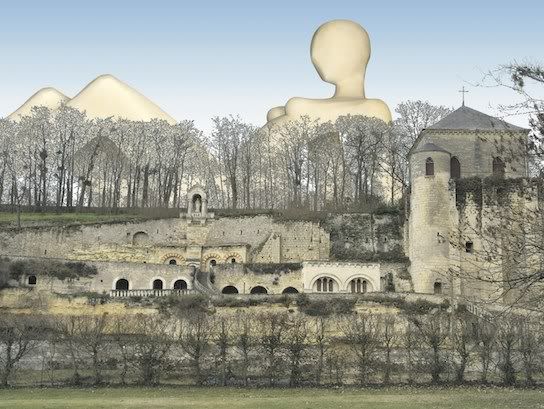
1. GalliaWatch has posted on a gargantuan sculpture that is to be placed behind the Marmoutier Abbey in France. It is the usual modern fare of the louder, bigger, kitchier, the better. There is no art in the piece.
Yet, why shouldn't this horrendous sculpture be placed there? France touts itself as a secular nation, and this abbey hasn't been functioning as a Christian center for generations. If people cannot even respect, let alone allow to function, their Christian institutions, then anything else is free to come and replace, or destroy, it.
Isn't that one of the successful strategies of Islam?
Here's what Wikipedia says about the Marmoutier Abbey:
The abbey was disestablished in 1799 during the French Revolution, and within a few decades the bulk of its buildings had been demolished. Today its grounds contain a private school, and of its former structures only a few ruins remain.
2. Ilana Mercer keeps repeating (and linking to) a mantra, "We are Doomed" interspersed in her blog posts. But like many things Mercer writes, it isn't even her original idea or thought. She borrowed it from a nihilistic book title by John Derbyshire, which Mercer is actively publicizing on her blog. Derbyshire's full title is: We Are Doomed: Reclaiming Conservative Pessimism. Isn't conservatism about optimism? We are confident that what we have is worth keeping, that it is positive and good. Of course, we base this on many things, one of which is our Christianity. And Christians and Conservatives Derbyshire and Mercer are not.
That really is the fundamental difference, isn't it, between pessimists and optimists. Pessimist believe in nothing, they are nihilists to the core. Their great system is to believe in doom, in nothing.
Mercer and Derbyshire do have their belief systems, but they lead directly to nihilism. Mercer's Libertarianism is her religion that excludes everything but the sacrosanct individual. The empty narcissist. No wonder this leads her to doom, and enter the "higher" realm of Derbyshire's belief system via his pathological liberalism, which is nihilism.
It is also a little infantile to just keep repeating "We are Doomed" scattered "liberally" in articles supposedly meant for sophisticated reading. But, I have never been impressed with Mercer's writing style either.
Although self-anointed intellectuals like Mercer and Derbyshire will never acknowledge this, their doom (and emptiness) is precisely the kind of emptiness that Islam (and evil) looks for, to fill up and influence that emptiness with something.
3. The bloggers at Gates of Vienna have posted an article on Sam Solomon. The writer of the article, Henrik R. Clausen, describes Solomon's background as a "retired Islamic scholar." Solomon, whom I describe as a "Muslim scholar and sharia law expert" never retired from Islamic scholarship. He simply stopped becoming a Muslim, and converted to Christianity. He is therefore an apostate. And because of the death threat hanging over his head, he has to go into hiding. Solomon hasn't shown any indication of retirement, and continues to write books on Islam while in hiding. His latest book, released in February 2010, is titled: Al-Yahud: Eternal Islamic Enmity and the Jews.
Voluntary retirement and forced withdrawal from public life due to a death threat hanging over one's head are two very different things. This is not a small error. The writers at Gates of Vienna should have called Clausen out on this. Many counter-Jihad movements like Gates of Vienna work on some wishful thinking premise that Islam can be reformed, and that those death threats are made, and followed through, by a tiny minority of Muslim fanatics. The reality is simply that apostates are required, by the Koran, to be purged and killed. All good Muslims believe this, and that means the majority of Muslims. Sam Solomon left Islam when he abdicated from his role as an Islamic scholar and sharia law expert and later converted to Christianity, and therefore he is considered an apostate. He will forever live in fear of being murdered.
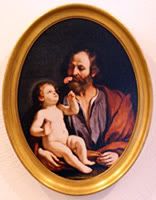
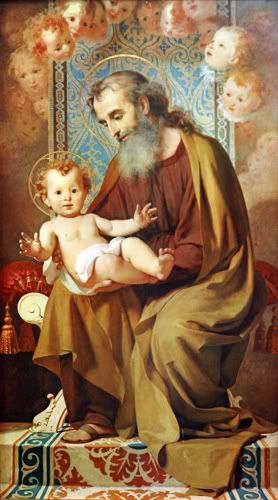
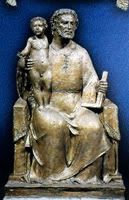
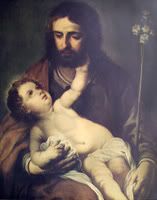
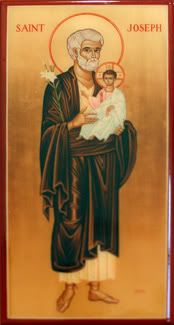
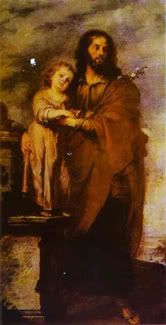
As we near Christmas, and we hear the lovely stories of Jesus's birth and his young mother Mary, I always feel that we keep his earthly father, Joseph, a little on the side-lines.
I am re-posting a segment I did on St. Joseph, and on the artists who painted him. These are purely subjective choices. I don't know if the paintings are masterpieces, or if some of the painters are even recognized in the roster of the Western canon. But, in many of the paintings, I found the gentleness with which Joseph interacted with his young infant touching.
Here is the website where I found most of these images.
[I've removed some works where Christ is already a young man in my original blog post. To view the complete post, you can go here.]
Jesus's Earthly Father Saturday, November 27, 2010
Left: St. Joseph. By Rudolph Blattler, Switzerland, 1899 Right: St. Joseph with the Christ Child. By Giovanni Francesco Barbieri, Italy, 1600s
Left: St. Joseph and Child. By Enrico Reffo, Italy, 1800s Right: Saint Joseph and Jesus. By Enrico Manfrini, Italy, 2000
Left: St. Joseph, The Holy Child. By Bartolome Esteban Murillo, Spain, 1600s Right: Holding Heaven. By Ron DiCianni, USA, 2004
Left: Saint Joseph with Child. By Brother Simeon, USA, 1900s Right:Joseph with Infant Christ. By Bartolome Esteban Murillo, Spain, 1655-56
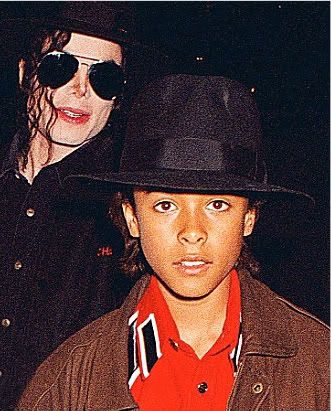
My previous post "Idiot" Libertarians" (I shouldn't have put "idiot" around scare quotes, because I will now put down my feet firm on the ground and call libertarians idiots) discussed Ilana Mercer's defense of Michael Jackson, who maintained a "friendship" with a twelve-year-old boy, including letting him sleep overnight in his bed. I genuinely asked her, in my long email which she reduced to ridicule and insults, why she was defending Michael Jackson.
Of course, I found the answer within my own words. According to libertarians, individualism trumps everything. Group norms are to be shunned unless doing so harms someone. So the individual can do whatever he wants as long as he doesn't harm anyone - and by harm libertarians mean anything physical or visible (although psychological harm is harder to detect unless the "victim" goes certifiably mad or something).
So, what harm did Michael Jackson cause? All he did was to bring the twelve-year-old Jordan Chandler into his bedroom. Surely, kids are sexual beings, and this one may have even enjoyed his romantic (sex)scapade sleeping in the the adult mega-pop star's bed. Mercer contends that "nothing" may have happened. A twelve-year-old boy sleeping overnight in the bed of a forty-something weirdo is not "nothing."
I believe that for libertarians, there should be no age limit for sexual interactions as sanctioned by Big Bad Government. So, setting protective criteria for young children in the face of untoward sexual experiences doesn't even enter their limited mental capacity.
I wonder if the truth will hit home when it becomes personal? Would Mercer have allowed her child at twelve to "sleep over" in an adult friend's bed - even a close and trusted friend? I think not. Odd how such a scenario becomes repulsive when personal relations are involved.
George Washington (The Athenaeum Portrait), 1796. Oil on canvas. By Stuart Gilbert. Jointly owned by the National Portrait Gallery, Smithsonian Institution, Washington, and the Museum of Fine Arts, Boston. [Click here to view a larger version]
I posted a Gilbert Stuart portrait of George Washington at Our Changing Landscape several weeks ago. I titled the post "The State of Affairs of our Modern World." It is actually a post on Geert Wilders's efforts to save his country from destruction by encroaching Islamization. His efforts are now slowly being recognized around the world. I saw a similarity between Wilders's hairstyle, which was being pettily attacked by some "writer" and George Washington's. My point, though, was bigger than superficial appearances. We need men like Wilders and Washington who can detect what a country needs to survive, and thrive, and who can articulate that vision and make it a reality.
The portrait I've posted above is one of three references that Stuart used to paint his hundreds of portraits of Washington. This particular one is called the Athenaeum Portrait after the Boston Athenaeum which originally bought it.
Here is what the National Gallery of Art says about the portraits developed from the Athenaeum:
Stuart began what would become his most reproduced image, a depiction of Washington facing left (to his right), now called the Athenaeum portrait for the Boston library that acquired it after Stuart’s death. Although he never finished the original itself, he used it throughout his career to make approximately seventy-five replicas, and the image––carefully built up with contrasting flesh tones––is one of Stuart’s most accomplished portraits.
The strikingly fresh aspect of this life portrait of Washington comes from Stuart's application of subtly varied skin tones in separate, unblended touches of the brush. His technique is visible even in the shaded areas under the chin, where Stuart alternated darker and lighter flesh tones to indicate shadow and reflected light. The president's white-powdered hair and blue eyes stand out in contrast.
The other originals which Stuart used as references are the Vaughan Portrait (Washington facing to his left),and the Lansdowne Portrait (Washington in full-length). The names are the owners of these originals. In the Athenaeum, Washington is facing to his right.
I wonder what prevented Stuart from finishing the Athenaeum? Apparently Washington was irritable when it came to having his portrait painted and didn't like the small talk (or the long sittings). But Stuart found his method, and engaged him with conversations on his favorite topic of horses. Still, Washington's portraits all exude a calm and steady temperament. Perhaps he felt that portrait-painting took too much time away from his important responsibilities. We should thank Stuart that he persevered, and that he painted these masterpieces. Pictures don't lie, at least I don't think they do. And they often succinctly tell us truths which can easily be camouflaged by clever words.
The Athenaeum is especially intriguing because it was unfinished. Perhaps Stuart was aiming for something bigger than he could handle. It is as though he was trying to emerge Washington out of some primordial matter, a force entering our world. But Stuart was trying to capture this with mere paint and canvas. If he erred with his approach, I don't think he erred with the subject he chose to attempt his idea with. This reminds me of another artist, sculptor Rodin, who says he chose the stones to sculpt from because he could already see the forms within the stones.