Showing posts with label Culture. Show all posts

Sunday, July 5, 2015

Of Dogs, Nazis and Truth

Gustav Klimt (1862-1918)
Adele Bloch-Bauer I
1907
Oil, silver, and gold on canvas
Neue Galerie New York


I've bought my summer book, which depletes my yearly book quota, which is three a year (it's only July!). The book is: The Lady in Gold: The Extraordinary Tale of Gustav Klimt's Masterpiece "Portrait of Adele Bloch-Bauer" by Anne-Marie O'Connor.

It was recommended to me by a staff at my local Chapters/Indigo bookstore, when I asked her for her advice. "I'm pretty sure you'll like this" she said. She had previously assisted me in finding/ordering/buying the two other books I recently bought - Ann Coulter's Adios America, which I've written/reviewed here, and The Founding Fathers at Home: The Building of America, 1735-1817, which became a delightful journey into the homes of these Founding Fathers, and about which I've written a brief post here. They are both serious books, Coulter's more so, but engaging and witty, and Magnate's is a joy to read about the homes, and rooms, where these American men conceived so many of their ideas.

If my quota weren't already over I would also buy a dog book. Now, dog books are a dime a dozen. Everybody has a Fido to biographize. But the New Yorker's book: The Big New Yorker Book of Dogs, which I saw online, is described thus:
Only The New Yorker could fetch such an unbelievable roster of talent on the subject of man’s best friend. This copious collection, beautifully illustrated in full color, features articles, fiction, humor, poems, cartoons, cover art, drafts, and drawings from the magazine’s archives.
These authors take their dog a tad too seriously. But such is the honor we should bestow our dog, loyal, silent (except for the bark or the growl to protect his master) playful, and infinitely patient. But, once in a while we should make gentle jokes about him. He is, after all, a dog.

As does Kurt Vonnegut, whose loopy novels I avidly read. In his book The Sirens of Titan, Kazak the dog (who has appeared in previous Vonnegut novels) belongs to Rumfoord, who comes:
...from a wealthy New England background. His private fortune was large enough to fund the construction of a personal spacecraft, and he became a space explorer. Traveling between Earth and Mars, his ship - carrying Rumfoord and his dog, Kazak - entered a phenomenon known as a chrono-synclastic infundibulum, which is defined in the novel as "those places ... where all the different kinds of truths fit together."
Even in outer-space, and a dog as sole companion, truth is important to decipher.

I might break my (personal) contract, and just buy Vonnegut's parody. He does have a dog as a protagonist, after all!

Now, onto those metaphorical dogs, or more appropriately, wolves. In the Garden of Beasts: Love, Terror and an America Family in Hitler's Berlin, by Erik Larsen is:
...a disturbing but highly compelling account of the life of the American ambassador to Germany and his family during Hitler’s rise to power. Larson, author of “The Devil in the White City” and other bestsellers, focuses on a narrow yet intriguing chapter of the buildup to the war: what life was like in Berlin among the social and political elite as Hitler became chancellor, told through the eyes of a most unusual ambassador and his family.
The Hitler regime is fascinatingly macabre. How could a whole civilization be taken in by this impostor? My layman's, naive, conclusion is that people abandoned God, and could no longer differentiate between good and evil, and between truth and falsehood, and in fact supported evil.

My latest book acquisition, mine for only a day now, is: The Lady in Gold: The Extraordinary Tale of Gustav Klimt's Masterpiece, Portrait of Adele Bloch Bauer. It is about the wolves of history, the Nazis.

Here is a review:
Anne Marie O'Connor...deeply researched account of the Bloch-Bauer case, "The Lady in Gold," concentrates almost entirely on the Neue Galerie's picture - along with the Belvedere's "The Kiss" (1907), the pre-eminent example of Klimt's now celebrated gold-leaf style - and the wrenching 20th-century tragedy of Vienna's highly assimilated Jewish elite. She has constructed a sprawling "saga of loss and redemption" that is as much an impassioned elegy for a "golden instant when Vienna rivaled Paris" as a dissection of the restitution battle that led to the Christie's sale.

The case is straightforward enough: The daughter of one of the leading bankers of the Austro-Hungarian empire, Adele Bloch-Bauer was a patron (and perhaps lover) of Klimt and a fervent supporter of public museums. In 1923, two years before her death, she wrote a will expressing her wish to have her Klimts given to the [Vienna's] Belvedere [Gallery] upon the death of her husband, the industrialist Ferdinand Bloch-Bauer. Following the 1938 Anschluss, however, Ferdinand's assets, including the paintings, were expropriated by the Nazis -"Aryanized"- and he fled to Czechoslovakia and then Switzerland, where he died in 1945. After the war, the Belvedere asserted title to the paintings, citing the 1923 will.

By the 1990s, however, Austria was drawing belated scrutiny for its handling of art looted by the Nazis, and, in 1998, the remaining Bloch-Bauer descendants, all living abroad, asserted claim to the five Klimts. Leading this effort were Maria Altmann, the octogenarian niece of Adele, and a crusading young American lawyer named Randol Schoenberg, who happened to be the grandson of the Austrian composer (and fellow émigré) Arnold Schoenberg. After a protracted legal battle, an Austrian restitution panel ruled in favor of the heirs in January 2006.

[...]

The central and largest section of Ms. O'Connor's book is devoted to the brutal destruction of their Vienna [by the Nazis].
So there you have it, "Of Dogs, Nazis and Truth."

Tuesday, June 2, 2015

Original Blog Header


This was the blog header I had for many years, as I was trying to understand the aggressive world of Islam as it made headways into our culture.

The newer ideas behind "Saving Our Landscape" are still about keeping our culture and civilization from usurpation by foreign elements, since Islam wouldn't have been so bold if our cultural elements had been stronger and more confident.

----------------------------------------------------------------------------------------


Shot of the Toronto Skyline, with the CN Tower and the Rogers Centre Dome, which is a baseball arena, resembling a mosque. I was actually not the one to realzie this association, but an Arabic television in Toronto, which uses it as its opening logo. I write about that here.

----------------------------------------------------------------------------------------


Logo from the television series (now discontinued) Little Mosque on the Prairie, which is a take on that original story Little House on the Prairie. Here is my post on this.


----------------------------------------------------------------------------------------


Halal KFC, more here.

----------------------------------------------------------------------------------------


Isna Halal Certification:
(ISNA = Islamic Society of North America)

----------------------------------------------------------------------------------------


Muslim Girl Magazine, the Canada-published monthly magazine is now discontinued.

----------------------------------------------------------------------------------------


Muslim architecture in downtown Toronto, which I've written about here.

----------------------------------------------------------------------------------------

Sunday, April 26, 2015

Behind the Scenes


These are the hard-working men, behind the scenes of Mississauga's revival. And they were all set in place by the city's last mayor, Hazel McCallion.

The question is of course if this is a real revival, which I think it has the makings of, or if it just adding infrastructure to accommodate the unmentionable: increased immigration.

I think it will in some way sort itself out. If the city revives itself in a true sense: higher quality buildings, a "luxury mall" as Square One is being structured, improved landscaping and surroundings with better parks and recreational areas, but above all a with a Canadian perspective, then it will attract for a longer term those that can afford to stay not just for quick real estate flips (buying and selling), but those who would stay to buy good homes for their families.

I am seeing more of the latter, which to my observations looks less Asian (Chinese and Indian) and more white (possibly those attracted form nearby cities, including Toronto).

Let's hope so.


The Jubilee Garden is full of magnolia trees.


The C-Cafe, which is adjacent to the Jubilee Garden, has two industrious chefs, cooking up their appetizing meals on a daily basis. Here is one, barely visible, preparing a dish.


I keep thinking they're brothers. "Cousins?" I asked, but not even that. "Then they must be from the same Welsh town," I joked. They looked Welsh to me.


These are the groundsmen preparing the area for a new addition in the Jubilee Garden: The Hazel Tree, in honor of the former (last) Mayor Hazel McCallion. What an apt recognition. A tough nut to crack! I asked them what they were working on, and it seems they were told only a few days ago the nature of the project. "I got the scoop!" I joked.


And Andrew Wickens, Parks Manager for the City of Mississauga, was in the garden discussing with other officials some details ont he tree, and the surrounding magnolia trees. He was kind enough to stand for a photograph.

He will be responsible for the Hazel Tree.

Hazel McCallion as mayor of Mississauga, sitting in a council session

Hazel McCallion on Mississauga's growth:
Growing up:
Growth is good, says Mississauga’s Hazel McCallion - within limits


Full article at: Toronto Star, Mar 27 2013
Facing pressure under Ontario’s Places to Grow Act to house more of the GTA’s population boom, Mississauga Mayor Hazel McCallion is pushing back.

At city council Wednesday, McCallion said Mississauga has accepted the province’s mandated growth targets but will not accept decisions by the Ontario Municipal Board that allow developers to build beyond those targets. The spurt of highrise construction is hurting the city’s already overstretched infrastructure, she said.
“They can’t be playing around with our land use like they do,” McCallion said of the province and the OMB, which rules on municipal and planning disputes.

Council unanimously passed a motion asking that Ontario’s Planning Act be amended so developers cannot appeal city council decisions to the OMB, if the city’s official plan is in compliance with Ontario’s growth strategy. The strategy sets municipal density targets that aim to encourage cities to build up rather than out.

McCallion and other councillors said developers, seeing profits in building even higher, are simply going to the OMB whenever they want densities for projects increased. The OMB then uses the growth plan as the rationale for ruling in favour of the developers. The end result is often more lucrative for builders, but puts pressure on already overstretched municipal services.

For Mississauga’s motion to take effect, it would have to be endorsed by Queen’s Park.

Councillors cited a number of high-density projects in Mississauga over the past few years that residents and council, adhering to the city’s official plan, opposed. But developers eventually got their way at the OMB [Ontario Municipal Board], they said.

“I am really concerned about the increased densities … our (infrastructure) is not designed to take the climate change and the increased densities,” McCallion said.
She said the increased densities beyond what , Mar 27 2013has been planned will cost Peel Region “at least a billion dollars” to take care of the extra garbage alone.

Thursday, February 17, 2011

Lara Logan: Bomb Raider

Angelina Jolie in Lara Croft: Tomb Raider

I was going to leave the Lara Logan story alone. After all, whatever happened to her, and not all writers are unanimous that she was actually raped, is still an assault and has left her incapacitated for now, and hospitalized. I'm pretty sure, though, that she will bounce back to resume her Lara Logan: Bomb Raider adventure out in the Orient (metaphorically, at least).

I became suspicious of her (actually, I would became suspicious of any female "war" correspondent, blond and pretty, who goes in the midst of war-mongering, sexually frustrated Muslim men) when I started hearing about her personal behavior right out there in the field. Here's what Wikipedia says about her:
Her husband [Joe Burkett] is a U.S. Federal Government defense contractor from Texas, whom she met in Iraq. They had a son in January 2009. Her previous husband, Jason Siemon, was a professional basketball player in the United Kingdom...Joe Burkett's former wife Kimberly Burkett, accused Lara Logan of breaking up their marriage. She was also said to have been courting Michael Ware, another reporter, at the same time as she became involved with Joe Burkett which was said to have resulted in a brawl between the two men.
While the suddenly prudish Wikipedia uses "courting" to describe whatever was going on between Ware and Logan, The New York Post throws out the word "fling" to describes more succinctly what they see. What she actually had was a fling within a fling. Michael Ware is subsequently (consequently?) divorced, as are both Logan and Burkett from their respective spouses, in order to get married to each other. This sounds steamy and romantic, but is as sordid as it gets. I wonder how long this "fling" at (re)marriage will last?

And why isn't Logan at home taking care of her vulnerable toddler, and instead running off ducking bombs? These points are important to consider. We have transferred tremendous responsibility to these people in times of war. We are depending on them to serve us responsibly during difficult, chaotic times. If they cannot do that, then let them set up their own backdrops for dangerous romances. Casablanca might work, but even those protagonists eventually preferred the good guys to the bad ones.

Thursday, January 20, 2011

Michelle Ma Belle - Revisited

Michelle Obama at the State Dinner for Chinese President Hu Jintao

[Cross-posted at Camera Lucida]

I had vowed not to do anymore fashion pieces on Michelle Obama. But this takes the cake. The dress she wore to the State Dinner for China's President Hu Jintao looks like some kind of modern tied-dye African costume, clumsily cut as though somewhat was "cut happy" with the scissors, and with parts which look like they were assembled together with safety pins. There is that odd asymmetrical, off-the-shoulder look that Obama seems to like so much. And she's holding some kind of miniature shawl (scroll down to the second image) which has no relation, either in design or in proportion, to the rest of the dress. Bloggers (and Drudge) are calling this her tribute to "China Red", but I don't see that, especially with all the black "tie-dye" criss-crossing pattern.

It always surprises me when Obama comes out with her dresses. I can find no way to relate to them, and their strangeness strikes me each time. Perhaps this really is her, unique, sense of dress. But, I will go further, as I have before, that she has nowhere to pull from that will give her good judgment on her choices. She might be the most visual (yet thoroughly ignored) manifestation of the Obama government. A government which bows down, literally, to foreign leaders, channeling something that is not at all an American tradition. In fact, it is so strangely alien, that it could be why people (journalists, bloggers) are stunned into silence by this behavior.

Just like Michelle's odd, culturally unrecognizable, dresses.

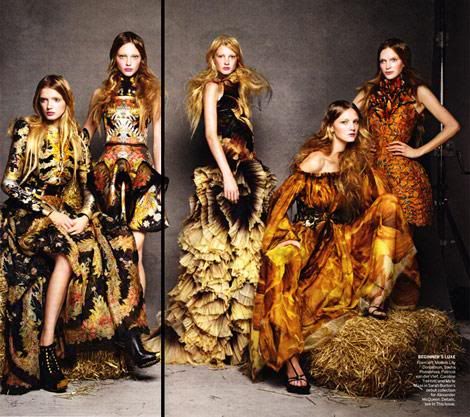
The dress was designed by Alexander McQueen's replacement, and long-time design partner, Sarah Burton. McQueen, a flamboyant homosexual, committed suicide in 2010. Burton designs these amorphous gowns with unrecognizable patterns It looks like she takes some rough shape and simply replicates it through mirroring and repeats

Burton was recently featured in January 2011's Vogue (US). The image below is a spread in the magazine. At first glance, the gowns looks impressive, dramatic even. But, fashion magazine buyers (like me, at least) look at details from shoes to buttons. Add to that my experience with textile design, and all I could say was 'This is fluff."


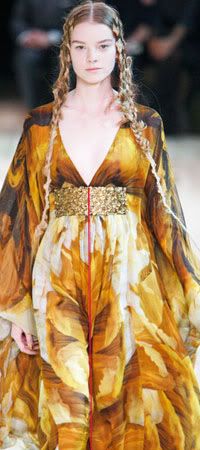
Look at this dress (it easier to work with) from the Paris Fashion Week (via the Los Angeles Times):


There is no discernible pattern, other than dramatic strokes (which look like flames, or a giant flower, but we're still not clear what it is). And I've added a line in the middle where the image has clearly been mirrored on to the other side.

Such design techniques are rudimentary and basic. This is one of the first things I did when I started my studies. Just quickly draw rough brush strokes, and mirror-copy them with the "mirror" angled at ninety, forty-five, etc. degrees.

Burton also seems to channel some kind of ethnic or multicultural sources. Here is a fashion blog Styling Delux who has posted some of Burton's designs. Two of them look like kimono-type gowns, and there is the dress Michelle wore which looks like an elaborate African-style gown. But, even African fashion is more sophisticated than that.

Burns is British. I seem to want to associate her with that British faux-artiste Damien Hirst, and his famous Butterfly Series, which he did with real live (dead) butterflies, which he also elaborated using mirror-imaging techniques. Burns also has a butterfly dress, replete with 3-D butterflies, which I hope are not real.

Wednesday, January 19, 2011

More Sino-Muscle Flexing


Nobody is writing about this, so my modest blog may as well tackle the taboo topics.

I've recently been repeatedly struck by aggressive Chinese behavior - whether it is subtly carried out like the narrowing in on white males by Chinese women (immigrant or ethnic), by cracks in Chinese mothering techniques by Chinese living in the West (I'm not interested in what Chinese do behind their own borders), and of course the Chinese going where they've never been before, siphoning off water from poor countries, for example, to alleviate their own disastrous policies. I won't even grace Obama's latest bow to Hu Jintao, in Washington, no less.

One of the effects of this wonderful cultural intrusion is that we get all the pagan and heathen superstitions that used to come in (Chinese) factory manufactured strips found in "fortune" cookies now spoken to us in their fuller versions by Chinese sages.

The Chinese don't like death, they don't like funeral parlors, and certainly not hospices. Residents of a Vancouver building are loudly protesting plans to build a hospice near their "million dollar" high rise apartments. They're appealing to (their) cultural taboos to abort this plan.

Here are some quotes from The Province (a British Columbia publication):

- "We cannot have dying people in our backyard," said rally organizer Janet Fan, Wednesday "It’s a cultural taboo to us and we cannot be close to so many dying people. It’s like you open your door and step into a graveyard."

- One resident says: "We believe that people dying outside will bring us bad luck," she added. "I’m very angry and upset. If I had known it was going to be a hospice, I wouldn’t buy it for half the price."

- Another, clutching her toddler son adds: "It’s very disturbing,”"she said. "My kids and I are going to feel so frightened and angry just to think there are dying people so close to us."

- And the this, in a letter addressed to the University Neighborhood Association:

"'Death is the Yin and 'Live' is the Yang,” it read. "If the Yin and Yang are near to each other, 'Death' will bring bad luck, meaning sickness and even death . . . The ghosts of the dead will invade and harass the living."

- The letter said Asians believe that living next to "death" would "lead to failure of business, the loss of money, the break of marriage and family, and the healthy growing up of children will be affected."

The paper compares this "opposition" to the building with other protesters. Namely, a group of students from University of British Columbia who didn't want to tone down their rowdy drunken parties.

Joe Stott, director of Campus and Community Planning, says: "[T]here’s no evidence that a hospice reduces property values.”

This could be a funny Saturday Night Live skit. But it's not that humorous. In the West, dignity is given even at death. Hospices are a dignified way for families to come to terms with a dying relative, and to have him spend the last days of his life in as much comfort (and dignity) as possible. I keep using the work "dignity" but it is not for lack of other words. I've written about the usurpation dignity that Chinese seem to practice. Of course critics will say that I don't have enough evidence, but we do get Chinese women writing quite explicitly about their lives, most recently Amy Chua's memoir, and in the various semi-autobiographical books that Amy Tan has written, showing has the ways that Chinese mothers humiliate their children (daughters, mostly, it seems).

So, I am not surprised that base desires and superstitious beliefs induce these Chinese (notice how all those interviewed, or at least providing their opinion, are women) Vancouver residents to act out inhumanely (this is what I wrote about Chua's treatment of her daughters) towards the dying.

Like the American Renaissance article titles this piece: Another crack in Canada’s multicultural edifice.

Sunday, January 16, 2011

A Sino-Draconian Mission


This unflattering portrayal of author Amy Chua
is posted in the the British leftist newspaper the Guardian

The paper labels the image with a quote from Chua's book Battle Hymn of the Tiger Mother:

"The solution to substandard performance is always to excoriate, punish and shame the child"

Incriminating imagery of a Western-culture denouncing non-white in a leftist newspaper? Chua is too much even for the Guardian.


----------------------------------------------------------------------------------
[Cross-posted at Camera Lucida]

I've noticed (and noted) a strange sinophilism going around these days. It doesn't matter if it is a left-wing or a right-wing commentator, the consensus seems to be that the Chinese (culture, at least) has got it right. One of these manifestations is the white male/Chinese female coupling I see all around me, which I've discussed here. In another post I discuss how Janice Stein, a University of Toronto academic who often appears on news shows as a political expert, excuses China's draconian measures towards its own work force by saying "that's the only way things can get done." Such behavior apparently translates down to family interactions, where Amy Chau, a Yale University law professor discloses her harsh intimidation methods to get her daughters to achieve "perfection" in her memoir Battle Hymn of the Tiger Mother.

I skimmed through a book review of Battle Hymn of the Tiger Mother in the January 2011 issue of Elle Magazine, but lost interest (or more like rolled my eyes), and stopped reading after the introductory paragraph:
A hyperachieving law prof and author from a cosmopolitan Chinese clan lays out a fearsome child-rearing philosophy.
Another Amy Tan type of book glorifying abusive Chinese mothers, I though.

Steve Sailer, from the anti-immigration website Vdare, which purports to eschew Western values, has posted a blog praising Amy Chau, and her draconian mothering and child-rearing techniques.

Sailer quotes from the New York Times review of Chua's memoire Battle Hymn of the Tiger Mother:
“In retrospect, these coaching suggestions seem a bit extreme,” she writes in the book after describing how she once threatened to burn her daughter’s stuffed animals if she did not play a piano composition perfectly. “On the other hand, they were highly effective.”

In interviews, she comes off as unresolved. “I think I pulled back at the right time,” she said. “I do not think there was anything abusive in my house.” Yet, she added, “I stand by a lot of my critiques of Western parenting. I think there’s a lot of questions about how you instill true self-esteem.”
Sailer adds a one-line comment:
One thing you can say for Ms. Chua is that she’s got guts.
Guts to bully and intimidate her children into becoming classical pianists?

Battle Hymn of the Tiger Mother is getting complementary reviews in many other venues.

- The Wall Street Journal ran an excerpt from Chua's book in early January. And allowed her to rebut the many negative comments she got from readers. Rather than write their own review, the editorial group at WSJ simply left the floor open to Chua. This is not a book review, but an underhanded way of giving a book a "pass".

- The reviewer from Macleans magazine from Canada, a spineless Joan Latmer writes, "I can’t think of a better rehab warden than Chua. The smart money’s on Tiger Mother."

- The Globe and Mail's Margaret Wente goes all out and praises non-white, non-Western parenting techniques which border on child abuse. Here's what she says about Andre Agassi's Iranian father training techniques:
Mike Agassi, a first-generation immigrant from Iran, taped Ping-Pong paddles to his son’s hands when he was just a toddler. At 6, Andre was practising four or five hours a day.
Agassi later confessed that he’s always hated tennis “with a dark and secret passion.”

Wente writes about Chua:
Instead of false praise, [Chua] believes in high standards and criticism. She once rejected a hastily scrawled birthday card that one of her daughters had made for her. “This is garbage,” she said. “You can do better.”
The snarky Wente continues:
Cruel? Maybe. But her older daughter, Sophia, has already played at Carnegie Hall. Your children probably haven’t.
Yes, anything to glorify the glorious non-West, and demonize the West, for these leftist Globe and Mail writers.

Chua relaxed her draconian methods and let her younger daughter give up piano for tennis. But, it's not necessarily generosity (or motherly love) that made her cede, but simply that she couldn't squeeze enough talent out of her unobliging daughter. Instead, she seems to have focused her classical-pianist-for-a-daughter needs on the eldest daughter.

But so far, Chua's promising older daughter has only played once at Carnegie Hall, and she's already eighteen. She's placed high in a couple of parochial competitions: second in a piano competition in the Greater Bridgeport Symphony competition for young musicians in 2010, and first at the Music Teachers National Association piano competition in 2006. She is no child prodigy, and might turn out to be a competent pianist, and end up in her mother's alma mater as the next best thing to a performer - a music teacher.

Part of the joy of perfecting something is because one loves it, or is encouraged to love it. Grueling practice sessions, time away from friends and play, and overcoming jittery nerves before performances are then usually worth the effort. I would wager that artists are willing to spend years of financial and social insecurity because they love their craft, and are willing to sacrifice other comforts to express that love. They could not function with a stick waving above their head.

When I was started to study ballet at a young age, I was so scared of my teacher (a Bulgarian communist who would tap my knee with a stick - "your k-nee, Kidist, your k-nee) that I failed miserably and was further humiliated at being removed from a school pageant. Yet later on, while a slightly older girl in the British school system, my teachers commended my grace (I also won a third-place prize at a local, regional competition). Later still, I joined many other dance groups, including a Mexican folk dance group often as a partner to the dance instructor/leader, an American modern dance ensemble where audience members would search for me to give me compliments, and even a belly dance group (I quit that one finding little art in it). I even organized and choreographed small groups for dance performances in college.

I never became a dancer, since I didn't have enough talent, and who knows what other social reasons excluded me from this art (including an emphasis on academics rather than the arts in my family), but I was never that incompetent young girl doing plies at the mercy of a teacher's stick. And many generous teachers instilled in me a love of dance which effaced the memory of the stick, and allowed me to continue to be thrilled by it all my life. I decided to enter an art-related field, and sometimes use music and dance (pattern) analogies to "compose" my work. Relying on that stick would have killed all of that.

Chua's unobliging daughter chose tennis for her second chance at doing something well. It is interesting that the similarity between her music and her sport is not that the fields are related, but that they are very different. Yet, there is an abstract, psychological similarity between the two (or at least the way Lulu Chua interacts with them). Competition seems to be the overriding factor, to "play" and win. Perhaps it was in her nature to be athletically competitive, and piano playing couldn't give her that. But, perhaps her mother's draconian (evil) methods that art is associated with pain, and even hate, simply clinched her decision.

Sunday, January 9, 2011

How a Focus on Culture Might Get at Imperceptible Societal Changes Quicker than Focusing Only on Politics


[Cross-posted at my culture blog Camera Lucida]

Politically-oriented magazines like Frontpage Magazine and American Thinker won't accept my "cultural" articles like The Structure of a Perfume: 5th Avenue by Elizabeth Arden, which I posted yesterday, unless I explicitly focus on politics.

I've tried to write purely political pieces since I understand we have an emergency in our hands:

- Muslim numbers in the West are increasing by the day
- Their actions are getting bolder, where they interject, with impunity, their social, legal, cultural and political structures into our Western societies
- Our streets are changing by the minute
- We have Chinese inundating our neighborhoods, arrogantly and loudly proclaiming their presence in their languages
- They are cleverly allowing their women to marry white men (the strange converse is not Chinese men with white women, but I'm seeing more and more of them with dark, black women).
- Chinese/white and Chinese/black will ultimately side against whites, and Western civilization. The reasons are complex, but I've observed this for many years now.
- All other non-white cultural groups will ultimately fight against Western civilization, however much they give a semblance of alliance for now. They realize the risks they're taking, running dry their water source. But they're willing to take the risk.
-Immigration is one of the reasons for this demographic and social change. And even second and third generation non-white immigrants have refused to adapt to the West. They take what they need, pay lip service where necessary, but continue with their determined (often unrecognized, even by them) task of changing the society to fit them.

But, I think the manifestation of these changes creeps into culture and society in imperceptible ways, at least to the layman. I think that such changes precede political articulations and manifestations. That is why I spend so much of my time assessing our culture and society with seemingly frivolous topics like fashion, design, Hollywood films, television, and so on. They show me that standards are being lowered. Hundreds of years of Western culture is being dismantled in the name of equality and multiculturalism. And no-one is immune. Spending thousands of dollars for what one would consider an authentic Christian Dior is really paying designers to play out their destructive fantasies - just look at John Galliano. And finally we have the real thing, Vera Wang, a Chinese-American designer.

Hitler didn't try to change Germany simply with political manipulations. He dug into the German culture, to destroy it. Then Germans became too weak to defend their civilization. We are getting at such a serious juncture in our era with Islam and Muslims specifically, and immigration in general.


We have now become simply numb to Islam's and Immigration's Transformation of our Society and Culture


A Muslim couple was caught in the biggest tax and immigration fraud in Toronto (Mississauga) and Montreal. Through this, around 300 people were given citizenship of permanent residency. All of these fraudulent immigrants are from Egypt. None of the newspapers or news stations dare say that this couple is Muslim, and that the "immigrants" are coming from Muslim countries. This despite the woman clearly dressed in a hijab, as seen on Canada's national news station, CTV. The couple both having Arabic names.

Even Jason Kenney, our infamous Immigration and Citizenship minister, refuses to use the dreaded "M" word, and instead calls them simply "foreign nationals." Here is an excerpt of what he said:
On January 6, 2011, an investigation by the Immigration and Passport and Commercial Crime sections of the RCMP resulted in criminal charges against three individuals who created the appearance that hundreds of individuals living overseas had met the residence obligation required to retain permanent resident status or to obtain Canadian citizenship...

In this investigation alone, 260 files were implicated and five people have obtained Canadian citizenship.
What is much more accurate than fraudulent immigration in describing this pattern is invasion. This is convenient until a critical mass is reached through this "immigration" and violent eradication of non-Muslims could become another strategy. We are now reaching that critical mass where Muslims can start to enforce their system through violent means if necessary, unless the country capitulates "voluntarily" to Islam. I'm still not sure which way the West will go. Jason Kenney's and other officials' statements indicate that our leaders have not understood this strategy. But, liberals hate religion as much as they love multiculturalism, so it is a toss-up if they will cave in and accept Islam "ideologically" (and become targets if they don't convert), or if they will start to eradicate it in order to promote their organized religion-free society. Still, pockets of violence will be eternally inevitable, since Muslims have to eradicate any dissension.

This invasion through immigration (or Al-Hijra), as originally mandated and practiced by Mohammed, is discussed in Islamic scholar Sam Solomon's latest book Modern Day Trojan Horse: Al-Hijra, The Islamic Doctrine of Immigration, Accepting Freedom or Imposing Islam?

Thursday, November 4, 2010

Article: "Zhang Yimou: Spokesman for China"

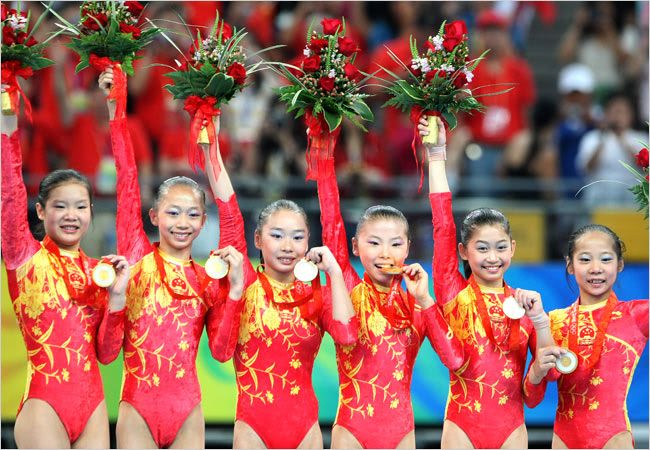
Chinese women's gymnastics team at the 2008 Beijing Olympics.
There persisted accusations of underage women (girls ?) Chinese gymnasts
throughout the Olympics.

Below is an article published in ChroWatch.com in September 2008: Zhang Yimou: Spokesman for China. The article is long - 881 words. But, I was trying to approach the 2008 Summer Olympics opening ceremonies from a visual perspective. Quite a bit of the article is descriptive, although I do go into analysis (including political) of the choices the head "designer" and filmmaker Zhang Yimou made to explain his motives, including his admiration for the North Korea.
------------------------------------------------------------------------------

Zhang Yimou: Spokesman for China
ChronWatch.com, September 13, 2008
Kidist P. Asrat

The opening ceremony of the Beijing Olympics was directed by the world-famous Oscar-nominated Chinese film director, Zhang Yimou. His exquisitely shot films show young brides, concubines, and peasant women consumed by the monolithic forces that these women (and it is often women) find themselves in.

The storylines of his films are often bewildering to Western viewers. Are we to sympathize with the characters, is Yimou agreeing with the forces of authority, and is he so fatalistic that he cannot see any other story? We are led to believe that the unique beauties--of the young girls, of the surrounding scenery, or in the case of  Ju Dou, the lusciously dyed textiles--will overcome anything. But they don’t, and these young women, once distinctive in their charms and their quests, can never escape their culture’s expectations, and are forced to sacrifice their individuality and singularity to the collective fabric of their communities in sad and tragic ways. Some go insane, others simply get old, and yet others bitterly, or blithely, try to forget.

Throughout China’s history, there seems to have been an overpowering preference for the individual’s submergence into the collective. Confucius lays out the ground rules for this coexistence, and Communism was the harshest, most inhumane, example of that history. Yimou is simply recording this cultural reality. He further demonstrates this with his direction of the Beijing Olympics opening ceremony. The spectacular ceremony consisted of thousands (15,000 in total) of Chinese performers shifting in huge carpets of precise and united movement.

The world of Chinese human coordination is brought to light when Yimou compares Chinese performers to those of North Korea. He says: “Other than North Koreans, there’s not one other country in the world that can achieve such a high quality of performance.” Yimou didn’t compare his 15,000 synchronized human bodies to American or European artistry, but to an enclosed, isolated extreme dictatorial state like North Korea.

While discussing his experience in working with Western actors, Yimou says: “[They] were so troublesome [because] in the middle of rehearsals they take two coffee breaks…[T]here can’t be any discomfort, because of human rights…[T]hey have all kinds [of] organizations and labor union structures. We’re not like that. We work hard; we tolerate bitter exertion.”[1] Like the suffering his heroines endure, Yimou confesses that he sees nothing wrong with exerting pressure and discipline on his performers to have them conform to his giant designs.

How different is he and the Chinese, then, from the isolated, dictatorial North Koreans, whose mass parades have garnered his respect? In the name of human collectivity, Yimou acknowledges that Chinese performers are, and should be, willing to tolerate abuses on their bodies, give up their basic human rights, and work under extreme conditions. Yimou’s comparison of neo-Communist, modern Chinese performers with North Koreans is depressingly retrograde. Despite glowing references by the world community, China is still stuck in its past.

Still, one cannot deny the importance of culture and history on a country’s artistic formation. Yimou’s artistic style, both in film and in his latest contribution to the opening ceremonies, is part of Chinese art and artistry, where harmony and cohesion trumps individuality and innovation. This is evident in Chinese watercolor paintings where composition--a concerted effort at harmony--supersedes individual artistic expression. As Yimou’s films themselves show, while his characters go through tremendous suffering and even tragedy, often the best he can come up with is an ambiguous acceptance of the status quo. Yimou’s outright nihilism or rage would be more understandable, instead of deferment to the collective which in many cases can only be achieved if the individual is sacrificed, like Songlian in Raise the Red Lantern, who goes insane rather than live through her atrocious life.

Olympics which took place in Westernized countries--the United States, Australia, and Greece to name a few--emphasized more individualized performances and content-rich opening ceremonies, rather than the mastery of synchronized masses. The human presence in these Western performances were a means to a narrative, where one idea leads to another in space and time to tell a story or to reach a point. Most of the Western programs had also a limited in number of performers, since their intention was to use them as actors in a story and not as bodies in giant designs.

Yimou’s primary purpose was to use his human subjects as anonymous forms to make stadium-sized patterns. There was no emphasis on time or space, and the performers were enclosed within their own tightly limited areas. The Western performers, on the other hand, both individuals and groups, often moved from one end of a stadium to another for a particular purpose--to reach a destination, to enter into a building, or as in the young boy in the boat from the Athens show, to reach shore.

Yimou’s shore has now come and gone. The Chinese had their chance to show the world what they were made of. Astute observers will notice that nothing much has really changed in modern China, as exemplified by even their most free commentator, an artist, who confesses admiration for the artistic endeavors of one of the harshest regime in the world, and admits that he emulates its style.

------------------------------------------------------

[1] "Zhang Yimou’s 20,000-Word Interview Reveals Secrets of Opening Ceremony," Nanfang Zhoumou (Guangzhou), August 14, 2008

Reference:
China's New Cultural Scene: A Handbook of Changes. Claire Huot. Duke University Press, 2000

References to post "Precedents to China Rising"


I've compiled the references to my previous post: Precedents to China Rising below.
------------------------------------------------------------------------------------
REFERENCES:

A. Below is the list of articles I have compiled, mostly in the early 2000s, probably as a reaction to 9/11. Oh yes, around this time, and a few years later, there were heated discussion in my classes where the Chinese students were condoning the Muslim hijackers with the cliché that "America got what it deserved."

1. BC Report - Cover Story - Article link no longer works
2. Canada Wide Open for Terrorists, Charles R. Smith, July 10, 2002, World Net Daily
3. China Reform Monitor No. 312, June 12, 2000 - Article link no longer works
4. Chinese Dreams, American Dreams, Sacha Matuszak, November 22, 2004, Antiwar.com
5. China targets Caribbean trade - Feb 19, 2005, CNN.Com. The link appears non-functioning at CNN, but here is a synopsis of the article still available at CNN:

China is waging an aggressive campaign of seduction in the Caribbean, wooing countries away from relationships with rival Taiwan, opening markets for its expanding economy, promising to send tourists, and shipping police to Haiti in the first communist deployment in the Western Hemisphere.
6. Finding the Real Source of Sept. 11,  Dr. Aleksandr Nemets and Dr. Thomas Torda, October 17, 2001, NewsMax.Com

Here are the first paragraphs of the Nemets/Torda article:
A month has passed since the Sept. 11 strikes. The world's focus has been on Osama bin Laden and his network -- but the connections to Russia and China exist and need more investigation.

A Chinese military handbook advised the use of civilian airline jets as "flying bombs" -- and evidence has surfaced about Russian "mafia" ties to bin Laden
7. CIA issues warning on China’s military efforts, February 16, 2005. FT.Com
8. Chinese Spies. Although I couldn't retrieve this article from the National Post, here is a list of google references when I typed in "Chinese Spies Canada"
9. The Fate of the Immigrant Ships, 2003. Pacific Rim Magazine
10. Tycoon to create $1.2B charity to Canada, The Star.com [Article link no longer works].
11. China lays the 'Bush Doctrine' ahead of U.S. poll. Originally from Reuters, November 2004.

B. On a much more current note, a few weeks ago, the news channels were filled with reports of China's saber waving in the south seas:

China stages live-fire war games in South China Sea amid slow-burning territorial disputes

C. Below are recent blog posts at Our Changing Landscape on China's current relations with Canada, and with the world:
China Rising
China Rising [Cont.]
Land Grab from the Poor to the Poor

D. These are the news program "The Agenda" videos of recent, full-hour episodes on China, on which I based some of my blog posts:

Fear and Facts about China
China's Economic Worries
Political Change in China?
Reinventing China's Economy 
China's Undervalued Renminbi

Sunday, November 25, 2007

The Underbelly of Belly Dance

There is a curious phenomenon that has been going on in North America and Europe for the past few decades. Thousands of women are ‘shamelessly displaying their femininity’ through a Middle Eastern dance form more dubiously known as belly dance.

The ‘Finding your Femininity through Belly Dance’ hype is actually the last vestiges of the so-called female liberation’s movement. Belly dance is advertised to Western women as a way to release their apparent inhibitions regarding their bodies. The undulations, body waves, hip circles and other abdomen-centric movements appear to glorify the unique feminine body. If you are not embarrassed at moving in these overtly erotic ways ( there is no other word to describe the movements in belly dance but as erotic), then you have come a long way, seems to be the message.

Many belly dance aficionados have tried to historically disassociate the dance from its erotic nature. An ancient Egyptian woman called the Almeh, who was well versed in poetry, music dance and other intellectual stimuli, is portrayed as having been the sophisticated cultivator of the dance. Yet, this description fits perfectly with the modern Japanese Geisha, who is a sexualized entertainer of men despite her erudition and education. The prestigious Almeh no longer exists in modern Egypt, if she ever really existed before.

The belly dance craze in North America started gaining momentum in the seventies and has been growing steadily since. Recently, belly dance schools have tapped onto the extraordinary success of the fitness movements. Gyms started giving belly dance classes along side aerobics. Even yoga centers brought in their belly dance teachers. Still, most women attend classes in belly dance schools at many convenient (and sometimes quite inconvenient) locations. Finally, the convergence into popular culture was sealed when overt eroticism became a daily routine on TV and in the movies. Belly dancing became something to do.

The majority of women say they started belly dancing to make themselves feel better. They’re searching for some kind of uninhibited narcissism – a feel good about their body - while doing all these undulations and shimmies. Their ultimate proclamation is "we don’t need men to make ourselves feel better" slogan that came out of the feminist movement. Yet quite contrary to this much advertised slogan, it is the poor men who become subjugated to the girl-power type of behavior (exhibited by grandmothers and granddaughters alike) and who end up supporting the dancers.

There is also the unexpected (or probably quite expected) competition. The urge to be a belly dancer can be a cut-throat experience. Gilded in clenched smiles and girlish voices, what everyone really wants is to stand center stage in full sequined costumes. As with every activity which does not quite reach the level of art, the acrobatics and costumes in belly dance act as substitutes for artistic sublimities. Belly dancing styles become a contortionist’s feat of moving as many parts of the stomach muscles as possible. In fact, its initiation into North America was at Chicago's "World's Columbian Exposition" in 1893, which introduced to the American public the 'dancing girls of the Middle East’, whose huge popularity was mainly as a circus act, along with the hoochy koochy label.

Many North American professional belly dancers guard closely that they hail from the much more artistic and cultivated discipline of ballet. They started dancing very young, as is required of ballet, and were rejected an entrance into this elite art form. Belly dancing offered them a chance to script their own standards, where the rigorous ballet judges cannot criticize them – what do they know about belly dance anyway?

The overriding promise of belly dance is that ‘you will feel better about all the failures that have derailed your life no matter what they are’ is really a message about masks and camouflage. The real issues are not addressed and resolved. What better way to forget the past than to immerse oneself in something so foreign that all those forgone defeats can be forgotten. Ironically, far from giving them the self-worth they crave, it puts them in an ambiguous relationship with the dance. Even in Middle Eastern circles, where belly dancers are hired for weddings and other festivities, it is still a dance that is frowned upon. Dancers are forever trying to find euphemisms for their dance, emphasizing its folk nature, or its erudite beginnings, or as a dance for pregnant women. Unlike ballet, a belly dancer can never proudly and publicly proclaim her profession.

Reference:
Donna Carlton. Looking for Little Egypt. Bloomington, Ind. : IDD Books, 1994.