Wednesday, November 10, 2010

Infatuation with China?


Western artists have always had a fascination with the exotic. China has figured high in that fascination, perhaps starting with Vasco Da Gama's quest to find the Chinese seas, and even Columbius circumnavigating the world, via China. And despite its great distance distance, there was humor in trying to get to China by digging a tunnel.

I think this fascination still holds.

Something triggered my numerous posts on China -

Friday, November 5, 2010

The Return of the Antichrist

Jim Kalb's most recent article on his web page is a transcript of his speech from the annual H.L. Mencken Club conference. It is titled: "PC, the Cultural Antichrist."

As I was reading through the material, I came across this paragraph, for which I should have been prepared:
If you try to get rid of religion, you aren't going to get rid of religion. Instead, you'll get some scheme of attitude and belief that functions like a religion but pretends to be something else and will probably go off in strange directions because nobody's allowed to think about what it really is. In short, you'll get something rather like the Antichrist.
I lazily read ahead of the very last sentence, substituting liberalism for "the Antichrist." I laughed out loud as I finished reading the sentence. Yes, we have to call things by their name. Kalb is making a case for the evil, or perhaps to be less fanatic, the inhuman nature of liberalism.

It gets better. I've been trying to get fascists and liberals together in my mind for a while now. Kalb writes this, as though in answer to my (silent) quest.
There are two basic solutions to those problems within modernity, the fascist one and the liberal one. The fascist solution is to say that purposes are objectively binding and therefore provide a standard of what's right if you get beaten up when you don't go along with them. On that view the purposes that count are the purposes of whoever's in a position to do the beating--that is, whoever is the top guy on the top team. So the basic principles of government are "we're number one" and "the will of the leader is the highest law."
It sounds like Triumph of the Will, the film produced by Leni Riefenstahl, Hitler's visual and artistic spokesman/handmaiden. The film, which every film student watches because it really is a feat in cinematography, begins with Hitler descending the heavens down to Nurenmberg, a divine creature (god himself) come to save the decadent Germans. Little did these common folk know that his project was their annihilation, and to raise something better from their ashes. The great Götterdämmerung. It almost worked, the annihilation part, anyway.

But as Kalb writes, fascism, whether in governments or in day-to-day interactions, loses because how much beating (metaphoric or literal) are people going to take? It seems that liberals are the high I.Q.ers of fascists, and are careful where and how they land their punches.

Kalb writes:
[Facism]'s a nice clear system, and it's got some logic behind it, but it doesn't work very well. It was tried and it lost. For that reason, the liberal solution won out.

That solution is a bit more complicated. It starts by noting that all our purposes are equally purposes, and infers that everybody's purposes equally confer value. Each of us is equally able to make things good or bad just by thinking of them as good or bad. That makes each of us in a sense divine. Our will creates moral reality. Instead of the wonder-working leader of fascism you get the divine me of liberalism. It's every man his own Jesus.
So how do liberal leaders get all these equally stationed demi-gods to follow them? It is still sheer will, I would think, of maintaining a semblance of liberal equality, but working with (and secretly ruling with) brute fascistic superiority, through a lot of lying and deceiving.

Below is a video of the opening scenes of Triumph of the Will, with a synopsis.
Day 1: The film opens with shots of the clouds above the city, and then moves through the clouds to float above the assembling masses below, with the intention of portraying beauty and majesty of the scene. The cruciform shadow of Hitler's plane is visible as it passes over the tiny figures marching below, accompanied by music from Richard Wagner's Die Meistersinger von Nürnberg, which slowly turns into the Horst-Wessel-Lied. Upon arriving at the Nuremberg airport, Hitler emerges from his plane to thunderous applause and a cheering crowd. He is then driven into Nuremberg, through equally enthusiastic people, to his hotel where a night rally is later held.

Thursday, November 4, 2010

Article: "Zhang Yimou: Spokesman for China"

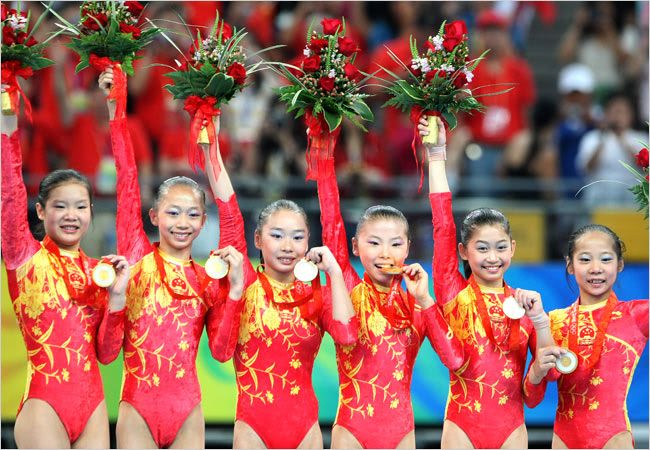
Chinese women's gymnastics team at the 2008 Beijing Olympics.
There persisted accusations of underage women (girls ?) Chinese gymnasts
throughout the Olympics.

Below is an article published in ChroWatch.com in September 2008: Zhang Yimou: Spokesman for China. The article is long - 881 words. But, I was trying to approach the 2008 Summer Olympics opening ceremonies from a visual perspective. Quite a bit of the article is descriptive, although I do go into analysis (including political) of the choices the head "designer" and filmmaker Zhang Yimou made to explain his motives, including his admiration for the North Korea.
------------------------------------------------------------------------------

Zhang Yimou: Spokesman for China
ChronWatch.com, September 13, 2008
Kidist P. Asrat

The opening ceremony of the Beijing Olympics was directed by the world-famous Oscar-nominated Chinese film director, Zhang Yimou. His exquisitely shot films show young brides, concubines, and peasant women consumed by the monolithic forces that these women (and it is often women) find themselves in.

The storylines of his films are often bewildering to Western viewers. Are we to sympathize with the characters, is Yimou agreeing with the forces of authority, and is he so fatalistic that he cannot see any other story? We are led to believe that the unique beauties--of the young girls, of the surrounding scenery, or in the case of  Ju Dou, the lusciously dyed textiles--will overcome anything. But they don’t, and these young women, once distinctive in their charms and their quests, can never escape their culture’s expectations, and are forced to sacrifice their individuality and singularity to the collective fabric of their communities in sad and tragic ways. Some go insane, others simply get old, and yet others bitterly, or blithely, try to forget.

Throughout China’s history, there seems to have been an overpowering preference for the individual’s submergence into the collective. Confucius lays out the ground rules for this coexistence, and Communism was the harshest, most inhumane, example of that history. Yimou is simply recording this cultural reality. He further demonstrates this with his direction of the Beijing Olympics opening ceremony. The spectacular ceremony consisted of thousands (15,000 in total) of Chinese performers shifting in huge carpets of precise and united movement.

The world of Chinese human coordination is brought to light when Yimou compares Chinese performers to those of North Korea. He says: “Other than North Koreans, there’s not one other country in the world that can achieve such a high quality of performance.” Yimou didn’t compare his 15,000 synchronized human bodies to American or European artistry, but to an enclosed, isolated extreme dictatorial state like North Korea.

While discussing his experience in working with Western actors, Yimou says: “[They] were so troublesome [because] in the middle of rehearsals they take two coffee breaks…[T]here can’t be any discomfort, because of human rights…[T]hey have all kinds [of] organizations and labor union structures. We’re not like that. We work hard; we tolerate bitter exertion.”[1] Like the suffering his heroines endure, Yimou confesses that he sees nothing wrong with exerting pressure and discipline on his performers to have them conform to his giant designs.

How different is he and the Chinese, then, from the isolated, dictatorial North Koreans, whose mass parades have garnered his respect? In the name of human collectivity, Yimou acknowledges that Chinese performers are, and should be, willing to tolerate abuses on their bodies, give up their basic human rights, and work under extreme conditions. Yimou’s comparison of neo-Communist, modern Chinese performers with North Koreans is depressingly retrograde. Despite glowing references by the world community, China is still stuck in its past.

Still, one cannot deny the importance of culture and history on a country’s artistic formation. Yimou’s artistic style, both in film and in his latest contribution to the opening ceremonies, is part of Chinese art and artistry, where harmony and cohesion trumps individuality and innovation. This is evident in Chinese watercolor paintings where composition--a concerted effort at harmony--supersedes individual artistic expression. As Yimou’s films themselves show, while his characters go through tremendous suffering and even tragedy, often the best he can come up with is an ambiguous acceptance of the status quo. Yimou’s outright nihilism or rage would be more understandable, instead of deferment to the collective which in many cases can only be achieved if the individual is sacrificed, like Songlian in Raise the Red Lantern, who goes insane rather than live through her atrocious life.

Olympics which took place in Westernized countries--the United States, Australia, and Greece to name a few--emphasized more individualized performances and content-rich opening ceremonies, rather than the mastery of synchronized masses. The human presence in these Western performances were a means to a narrative, where one idea leads to another in space and time to tell a story or to reach a point. Most of the Western programs had also a limited in number of performers, since their intention was to use them as actors in a story and not as bodies in giant designs.

Yimou’s primary purpose was to use his human subjects as anonymous forms to make stadium-sized patterns. There was no emphasis on time or space, and the performers were enclosed within their own tightly limited areas. The Western performers, on the other hand, both individuals and groups, often moved from one end of a stadium to another for a particular purpose--to reach a destination, to enter into a building, or as in the young boy in the boat from the Athens show, to reach shore.

Yimou’s shore has now come and gone. The Chinese had their chance to show the world what they were made of. Astute observers will notice that nothing much has really changed in modern China, as exemplified by even their most free commentator, an artist, who confesses admiration for the artistic endeavors of one of the harshest regime in the world, and admits that he emulates its style.

------------------------------------------------------

[1] "Zhang Yimou’s 20,000-Word Interview Reveals Secrets of Opening Ceremony," Nanfang Zhoumou (Guangzhou), August 14, 2008

Reference:
China's New Cultural Scene: A Handbook of Changes. Claire Huot. Duke University Press, 2000

References to post "Precedents to China Rising"


I've compiled the references to my previous post: Precedents to China Rising below.
------------------------------------------------------------------------------------
REFERENCES:

A. Below is the list of articles I have compiled, mostly in the early 2000s, probably as a reaction to 9/11. Oh yes, around this time, and a few years later, there were heated discussion in my classes where the Chinese students were condoning the Muslim hijackers with the cliché that "America got what it deserved."

1. BC Report - Cover Story - Article link no longer works
2. Canada Wide Open for Terrorists, Charles R. Smith, July 10, 2002, World Net Daily
3. China Reform Monitor No. 312, June 12, 2000 - Article link no longer works
4. Chinese Dreams, American Dreams, Sacha Matuszak, November 22, 2004, Antiwar.com
5. China targets Caribbean trade - Feb 19, 2005, CNN.Com. The link appears non-functioning at CNN, but here is a synopsis of the article still available at CNN:

China is waging an aggressive campaign of seduction in the Caribbean, wooing countries away from relationships with rival Taiwan, opening markets for its expanding economy, promising to send tourists, and shipping police to Haiti in the first communist deployment in the Western Hemisphere.
6. Finding the Real Source of Sept. 11,  Dr. Aleksandr Nemets and Dr. Thomas Torda, October 17, 2001, NewsMax.Com

Here are the first paragraphs of the Nemets/Torda article:
A month has passed since the Sept. 11 strikes. The world's focus has been on Osama bin Laden and his network -- but the connections to Russia and China exist and need more investigation.

A Chinese military handbook advised the use of civilian airline jets as "flying bombs" -- and evidence has surfaced about Russian "mafia" ties to bin Laden
7. CIA issues warning on China’s military efforts, February 16, 2005. FT.Com
8. Chinese Spies. Although I couldn't retrieve this article from the National Post, here is a list of google references when I typed in "Chinese Spies Canada"
9. The Fate of the Immigrant Ships, 2003. Pacific Rim Magazine
10. Tycoon to create $1.2B charity to Canada, The Star.com [Article link no longer works].
11. China lays the 'Bush Doctrine' ahead of U.S. poll. Originally from Reuters, November 2004.

B. On a much more current note, a few weeks ago, the news channels were filled with reports of China's saber waving in the south seas:

China stages live-fire war games in South China Sea amid slow-burning territorial disputes

C. Below are recent blog posts at Our Changing Landscape on China's current relations with Canada, and with the world:
China Rising
China Rising [Cont.]
Land Grab from the Poor to the Poor

D. These are the news program "The Agenda" videos of recent, full-hour episodes on China, on which I based some of my blog posts:

Fear and Facts about China
China's Economic Worries
Political Change in China?
Reinventing China's Economy 
China's Undervalued Renminbi

Wednesday, November 3, 2010

Precedents to China Rising


China's rising confidence is becoming more apparent. Here is a Drudge heading (from the Financial Post): China rebuffs US offer on disputed islands, where China appears to be going beyond normal territorial claims and may be antagonizing the U.S. as well as a number of other Asian and non-Asian countries.

Recently, I've written several posts on China's saber rattling, and even actually entering a foreign land to acquire precious materials (references are at the end of this posting).

But I've been collecting files on China and the Chinese (whether in Asia or here in Canada and the U.S.) since about 2004. I don't know what triggered off the initial search, but I think it was a vague unease at the green light we have been giving Chinese to enter and do as they will in Western society, and also clearly a kind of off-shore colonization they're performing in African countries.

Part of my awareness of these issues is due to my teaching post as an English as a Second Language instructor, where I taught for four years at a Chinese community center. I asked to be placed there because I thought there would be better students, and I wouldn't have to go through mind-numbing elementary material.

Well, I was relatively impressed with the students' progress; I was able to enter discussions (with pronunciation and vocabulary exercises) dealing with politics, culture, Canada - of course, the United States - it was always interesting to watch how much these students would malign America which I countered forcefully and often with winning arguments, and a whole myriad of things.

Finally, I left (abruptly to my supervisors) after some months of reflection. My main reason (which I of course didn't disclose) was that I didn't find any sense of commitment to Canada by these Chinese immigrants (or Chinese newcomers, as the ESL crowd called them). In fact, I thought I was giving them too much information with which they can continue their Chinese alliances (and affinities) while seeing what they can claim from Canada. I got this impression from discussions during the class. In one class I got the students to sing the Canadian national anthem, partly as a reaction to their anti-Canadianism during a discussion, standing up. Some refused to sing, others made a fuss about getting up. That's when I knew my days were numbered.

--------------------------------------------------------------------------------------------------
REFERENCES:

A. Below is the list of articles I have compiled, mostly in the early 2000s, probably as a reaction to 9/11. Oh yes, around this time, and a few years later, there were heated discussion in my classes where the Chinese students were condoning the Muslim hijackers with the cliché that "America got what it deserved."
1. BC Report - Cover Story - Article link no longer works
2. Canada Wide Open for Terrorists, Charles R. Smith, July 10, 2002, World Net Daily
3. China Reform Monitor No. 312, June 12, 2000 - Article link no longer works
4. Chinese Dreams, American Dreams, Sacha Matuszak, November 22, 2004, Antiwar.com
5. China targets Caribbean trade - Feb 19, 2005, CNN.Com. The link appears non-functioning at CNN, but here is a synopsis of the article still available at CNN:
China is waging an aggressive campaign of seduction in the Caribbean, wooing countries away from relationships with rival Taiwan, opening markets for its expanding economy, promising to send tourists, and shipping police to Haiti in the first communist deployment in the Western Hemisphere.
6. Finding the Real Source of Sept. 11,  Dr. Aleksandr Nemets and Dr. Thomas Torda, October 17, 2001, NewsMax.Com

Here are the first paragraphs of the Nemets/Torda article:
A month has passed since the Sept. 11 strikes. The world's focus has been on Osama bin Laden and his network -- but the connections to Russia and China exist and need more investigation.

A Chinese military handbook advised the use of civilian airline jets as "flying bombs" -- and evidence has surfaced about Russian "mafia" ties to bin Laden
7. CIA issues warning on China’s military efforts, February 16, 2005. FT.Com
8. Chinese Spies. Although I couldn't retrieve this article from the National Post, here is a list of google references when I typed in "Chinese Spies Canada"
9. The Fate of the Immigrant Ships, 2003. Pacific Rim Magazine
10. Tycoon to create $1.2B charity to Canada, The Star.com [Article link no longer works].
11. China lays the 'Bush Doctrine' ahead of U.S. poll. Originally from Reuters, November 2004.

B. On a much more current note, a few weeks ago, the news channels were filled with reports of China's saber waving in the south seas:
China stages live-fire war games in South China Sea amid slow-burning territorial disputes

C. Below are recent blog posts at Our Changing Landscape on China's current relations with Canada, and with the world:
China Rising
China Rising [Cont.] 
Land Grab from the Poor to the Poor

D. These are the news program "The Agenda" videos of recent, full-hour episodes on China, on which I based some of my blog posts:
Fear and Facts about China
China's Economic Worries
Political Change in China?
Reinventing China's Economy 
China's Undervalued Renminbi

Conservative Leanings, Even in Canada


We recently had mayoral elections in Toronto. I had no idea which way things would go. Toronto is the most multicultural city in Canada, and in North America, and that usually means the Liberal Party wins hands down.

But, we were in for a surprise, and the Conservative candidate, Bob Ford, took the trophy. And all this despite his opponents trying to tarnish his background as a former drug dealer and thief - all about twenty years ago.

The results show that the majority of the ethnic groups voted for Ford. One can attribute this to the conservative inclinations of these groups, but I say that it is simply greed, or a desire to protect their money. Who want to fund, endlessly, social programs for groups one has no affinity towards? Multicultural sounds nice and cohesive, but groups stay with their own, despite generational ---- link to Indian posts -----.

As soon as Ford starts true Conservative principles, ethnic groups will return to what they do best, which is to vote Liberal.

Tuesday, November 2, 2010

Conservative Leanings, Even in Canada


We recently had mayoral elections in Toronto. I had no idea which way things would go. Toronto is the most multicultural city in Canada, and in North America ---- post immigration blogs and Kenney's fake reduction-----, and that usually means the Liberal Party wins hands down.

But, we were in for a surprise and the Conservative candidate, Bob Ford, took the trophy. And all this despite his opponents trying to tarnish his background as a former drug addict and thief - all about twenty years ago. The NDP candidate, Smitherman, also couldn't escape his background.

The election results show that the majority of the ethnic groups voted for Ford. One can attribute this to the conservative inclinations of these groups, but I say that it is simply greed, or a desire to protect their money. Who want to fund, endlessly, social programs for groups one has no affinity towards? Mutlicultural sounds nice and cohesive, but groups stay with their own, despite generational ---- link to Indian posts -----.

As soon as Ford starts true Conservative principles, ethnic groups will return to what they do best, which is to vote Liberal, which in reality is more left than centrist.

So, yes, there is a Conservative trend here in Toronto, but I wouldn't count on it as based on principles, but rather protecting one's purse.