Sunday, November 28, 2010

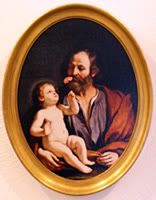
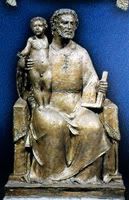
St. Joseph and the Infant Christ

[Cross-posted at Camera Lucida].

As we near Christmas, and we hear the lovely stories of Jesus's birth and his young mother Mary, I always feel that we keep his earthly father, Joseph, a little on the side-lines.

I am re-posting a segment I did on St. Joseph, and on the artists who painted him. These are purely subjective choices. I don't know if the paintings are masterpieces, or if some of the painters are even recognized in the roster of the Western canon. But, in many of the paintings, I found the gentleness with which Joseph interacted with his young infant touching.

Here is the website where I found most of these images.

[I've removed some works where Christ is already a young man in my original blog post. To view the complete post, you can go here.]


Jesus's Earthly Father
Saturday, November 27, 2010

Left: St. Joseph. By Rudolph Blattler, Switzerland, 1899
Right: St. Joseph with the Christ Child.
By Giovanni Francesco Barbieri, Italy, 1600s


Left: St. Joseph and Child. By Enrico Reffo, Italy, 1800s
Right: Saint Joseph and Jesus. By Enrico Manfrini, Italy, 2000

Left: St. Joseph, The Holy Child.
By Bartolome Esteban Murillo, Spain, 1600s
Right: Holding Heaven. By Ron DiCianni, USA, 2004


Left: Saint Joseph with Child. By Brother Simeon, USA, 1900s
Right:Joseph with Infant Christ. By Bartolome Esteban Murillo,
Spain, 1655-56


Idiot Libertarians - No Scare Quotes This Time

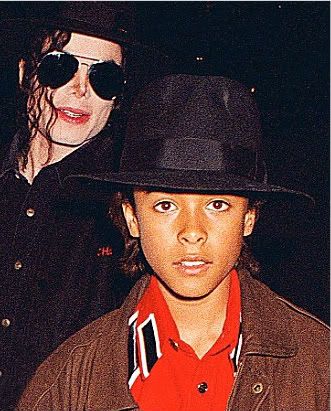
Jordan Chandler

My previous post "Idiot" Libertarians" (I shouldn't have put "idiot" around scare quotes, because I will now put down my feet firm on the ground and call libertarians idiots) discussed Ilana Mercer's defense of Michael Jackson, who maintained a "friendship" with a twelve-year-old boy, including letting him sleep overnight in his bed. I genuinely asked her, in my long email which she reduced to ridicule and insults, why she was defending Michael Jackson.

Of course, I found the answer within my own words. According to libertarians, individualism trumps everything. Group norms are to be shunned unless doing so harms someone. So the individual can do whatever he wants as long as he doesn't harm anyone - and by harm libertarians mean anything physical or visible (although psychological harm is harder to detect unless the "victim" goes certifiably mad or something).

So, what harm did Michael Jackson cause? All he did was to bring the twelve-year-old Jordan Chandler into his bedroom. Surely, kids are sexual beings, and this one may have even enjoyed his romantic (sex)scapade sleeping in the the adult mega-pop star's bed. Mercer contends that "nothing" may have happened. A twelve-year-old boy sleeping overnight in the bed of a forty-something weirdo is not "nothing."

I believe that for libertarians, there should be no age limit for sexual interactions as sanctioned by Big Bad Government. So, setting protective criteria for young children in the face of untoward sexual experiences doesn't even enter their limited mental capacity.

I wonder if the truth will hit home when it becomes personal? Would Mercer have allowed her child at twelve to "sleep over" in an adult friend's bed - even a close and trusted friend? I think not. Odd how such a scenario becomes repulsive when personal relations are involved.

Thursday, November 25, 2010

Happy Thanksgiving

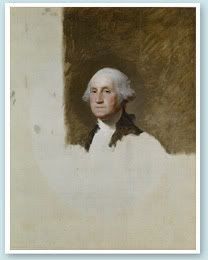
George Washington
The Athenaeum Portrait
, 1796.
By Stuart Gilbert.
[Click here to view a larger version]

Happy Thanksgiving


Wednesday, November 24, 2010

Happy Thanksgiving

George Washington
(The Athenaeum Portrait)
, 1796.
Oil on canvas. By Stuart Gilbert.
Jointly owned by the National

Portrait Gallery, Smithsonian
Institution, Washington, and the
Museum of Fine Arts, Boston.
[Click here to view a larger version]

Happy Thanksgiving

Monday, November 22, 2010

"Idiot" Libertarians

There is inspiring and highly informative discussion going on at the View from the Right on libertarianism [1, 2, 3, 4]. I linked to the resident online ex-Canadian libertarian Ilana Mercer, to see her input in this discussion. Her board is silent on this topic.

A few years ago, I exchanged civil emails with Mercer. After a while, I questioned Mercer's nationalism, or more precisely, her volatile views on nationalism, and that her libertarian stance doesn't adequately answer questions of nationalism. It was a serious concern, and one that I presented in good faith.

Here is her answer. A few impersonal lines with carefully camouflaged insults:
The other laughable issue is the accusation that I lack a healthy nationalism.
Again, bloggers proudly display their absolute ignorance--they
have no qualms about never studying the object of their expansive, idiot, smug comments. What's this if not an argument for authentic nationhood? [Here, Mercer provides a link to an article she wrote on nationalism]. Nation, State, Mass Immigration. There are stacks more in my immigration archive but one wouldn't expect anything but empty assertions from this corner.
This is my long answer:
Firstly, the internet is an impersonal venue, and criticism of other bloggers and sites is in fair order. But rudeness is not my trait nor my character.

Secondly, I do not have the time to cull through all the essays that you have written, believing that the important information should come from the WND posts I read at times, and your blog I visit, also at times. I am not here to discuss philosophical and political-philosophical issues. I am neither a politician nor philospher. But, I have a great interest in nationhood.

During my brief visits, these are the things that caught my attention: (I do not have the time to find the links.)

1.  On a comment about collective feelings of grief, you made that sound like an impossibility, since only “individuals” feel grief. Yes, nations grieve, nations  rejoice. This is not a communist thing. Of course it is composed of individuals, and of course each individual grieves idiosyncratically. But, a collective grief does occur. I was struck by your inability to see this.

2. Your defence of [Canadian] Conrad Black, who has been cavorting from one country to another as long as his business and personal gains are met, surprised me. This is what I meant that at times your “legality” of issues sometimes trumps the “morality”. Why spend so much time defending him?

3. I’ve never seen you write, except briefly at the very end of this essay identifying “nation” and “state”, about your American way of life. Perhaps that is your style. Perhaps it is all too new. As a new immigrant, for example, do you think you could love America? Have you ever loved Canada, South Africa, Israel? Is America now a convenient place? Anyone can write your quaint description of a small town USA, but still have no nationalistic feelings.

Since you have already quoted Lawrence Auster in your article about immigration, did you come to America because you were like: “…those immigrants were not just anyone who wanted to come; they were people who loved America and were becoming fully a part of it”, as he describes Reagan’s letters on his blog, albeit with apprehension?

4. Your defence of Michael Jackson, which I heard on a radio station a while back, was worthwhile, and interesting. I of course esteem and honor the rule of law system that the Western system has put together. But, I also believe it came from a deeper, moral source. A non-Judeo Christian West could never have come up with these specific kinds of laws to protect people. I understand someone has to keep reminding us. But there is something strange defending (unless one is a defence lawyer, and hats off to them) such a strange man. What example is he to children, what regular "little" sins does he commit? Anyway, yes the law can absolve him, but look at him now.

So, your insinuation of my simplistic mind reminds me of my field of expertise, which is art and design. Many times, the most insightful and succinct observations, and usually the most honest, come from the non-experts. If I listen to them, my work usually becomes all the better (peppered with my expertise, of course). I believe daily life is the same, as the Minute Men keep showing everybody - pundits, politicians and journalists alike.

KPA
No more "smug comments" coming from her blog at the moment.

Sunday, November 21, 2010

Forces of Nature

George Washington
(The Athenaeum Portrait)
, 1796.
Oil on canvas. By Stuart Gilbert.
Jointly owned by the National 

Portrait Gallery, Smithsonian
Institution, Washington, and the
Museum of Fine Arts, Boston.
[Click here to view a larger version]

(This article is cross-posted at Camera Lucida.)

I posted a Gilbert Stuart portrait of George Washington at Our Changing Landscape several weeks ago. I titled the post "The State of Affairs of our Modern World." It is actually a post on Geert Wilders's efforts to save his country from destruction by encroaching Islamization. His efforts are now slowly being recognized around the world. I saw a similarity between Wilders's hairstyle, which was being pettily attacked by some "writer" and George Washington's. My point, though, was bigger than superficial appearances. We need men like Wilders and Washington who can detect what a country needs to survive, and thrive, and who can articulate that vision and make it a reality.

The portrait I've posted above is one of three references that Stuart used to paint his hundreds of portraits of Washington. This particular one is called the Athenaeum Portrait after the Boston Athenaeum which originally bought it.

Here is what the National Gallery of Art says about the portraits developed from the Athenaeum:
Stuart began what would become his most reproduced image, a depiction of Washington facing left (to his right), now called the Athenaeum portrait for the Boston library that acquired it after Stuart’s death. Although he never finished the original itself, he used it throughout his career to make approximately seventy-five replicas, and the image––carefully built up with contrasting flesh tones––is one of Stuart’s most accomplished portraits.
Here is what the Metrepolitan Museum of Art says about Stuart's technique for the Athenaeum portrait:
The strikingly fresh aspect of this life portrait of Washington comes from Stuart's application of subtly varied skin tones in separate, unblended touches of the brush. His technique is visible even in the shaded areas under the chin, where Stuart alternated darker and lighter flesh tones to indicate shadow and reflected light. The president's white-powdered hair and blue eyes stand out in contrast.
The other originals which Stuart used as references are the Vaughan Portrait (Washington facing to his left),and the Lansdowne Portrait (Washington in full-length). The names are the owners of these originals. In the Athenaeum, Washington is facing to his right.

I wonder what prevented Stuart from finishing the Athenaeum? Apparently Washington was irritable when it came to having his portrait painted and didn't like the small talk (or the long sittings). But Stuart found his method, and engaged him with conversations on his favorite topic of horses. Still, Washington's portraits all exude a calm and steady temperament. Perhaps he felt that portrait-painting took too much time away from his important responsibilities. We should thank Stuart that he persevered, and that he painted these masterpieces. Pictures don't lie, at least I don't think they do. And they often succinctly tell us truths which can easily be camouflaged by clever words.

The Athenaeum is especially intriguing because it was unfinished. Perhaps Stuart was aiming for something bigger than he could handle. It is as though he was trying to emerge Washington out of some primordial matter, a force entering our world. But Stuart was trying to capture this with mere paint and canvas. If he erred with his approach, I don't think he erred with the subject he chose to attempt his idea with. This reminds me of another artist, sculptor Rodin, who says he chose the stones to sculpt from because he could already see the forms within the stones.

Thursday, November 18, 2010

Demise


For the past several months, I have noticed a trend where China and the Chinese have been given undue deference by Western media and cultural institutions. In fact, just this evening, the Toronto public television, Television Ontario, had a panel discussing the  twenty million dollars scholarship program allocated by the Ontario government to bring in up to 300 foreign students per year (it apparently starts with 75/year and will go up as high as 300) to study in Ontario's universities. A Macleans magazine report says that Dalton McGuinty, the province's premier, went to Hong Kong recently to announce this initiative. The article, which is generally against this initiative, is titled: "McGuinty's solutions aren't in China" so I presume that the majority of these scholarships will go to students of Chinese origin, whether from Hong Kong or from mainland China. The TVO panel rationalized this huge government funding by saying that the Chinese students will "pay back" the generous Ontario government by staying on and working miracles for the Ontario government.

This is of course lop-sided thinking. Chinese students don't even need a $40,000/year scholarship to go to university in Ontario, and later on to be specially hired as a gesture of gratitude in lucrative engineering or technical jobs with high salaries. Chinese are applying as immigrants to Canada by the thousands, and many are bringing their life's savings just to be given a chance to get here. They are paying to come here.

One of the arguments the conservative panelist, Jim Wilson, brought up was that all this scholarship money is being siphoned off from funds that would go to students from Ontario instead. He kept asking why bring in students from China, train them, and have them build the bridges and highways, when Ontario students can do all that just as well. These points were unceremoniously dismissed by the rest of the panel members.

I think this all goes back to this strange infatuation the West, at least North America, is having with the Chinese. If I were to analyze it and give it a syndrome, I would say it is a fear of the bogey-dragon. China has waved its tail around, and we have taken fright. It is the "China rising" perception I have blogged about here and here.

Yet, everything China has done so far has been on the backs of the West. Sending masses of people to immigrate to Canada is a form of colonization, not only to take advantage of the country, but also to have Chinese representatives in the West who can feed the "motherland" with important information. This is called spying, and Chinese students and immigrants have been caught doing just that. But, it is more far-reaching than that. Second and third generation offspring of Chinese immigrants predominantly associate with their Chinese heritage. Even the high Chinese/White marriages in Canada (usually Chinese women with white men, although that is reversing now, and I'm seeing many more black/Chinese couples) results with half Chinese offspring, who associate far more with their Chinese parentage. This is understandable because they look more Chinese than anything else.

All this has implications for a country. If a country cannot even trust its own citizens to be loyal to it, then it surely is the beginning of its demise. And worse, if it starts accepting foreigners who have shown a lack of deference and loyalty to it, then it is surely a form of suicide. This is where I think the Chinese story I've been trying to unravel for the past several weeks is leading. Canada has diluted is sense of country and peoples so much, through decades of multicultural policies and high immigration rates, that a stronger and more confident group is simply waiting in the wings to take over. And why not the Chinese, in all their variations, immigrants, several-generation citizens, half white/black/French/Polish, and so on.